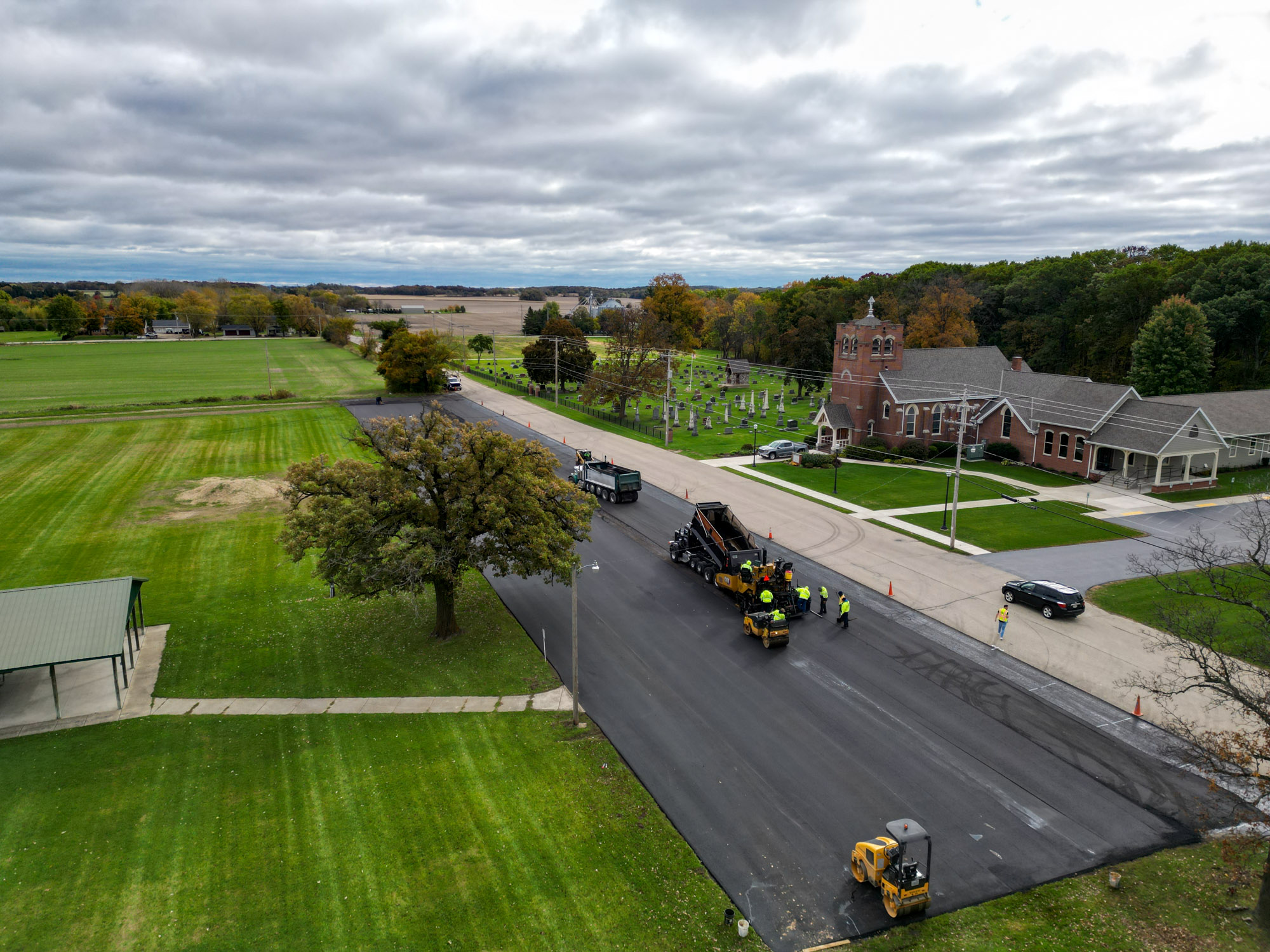
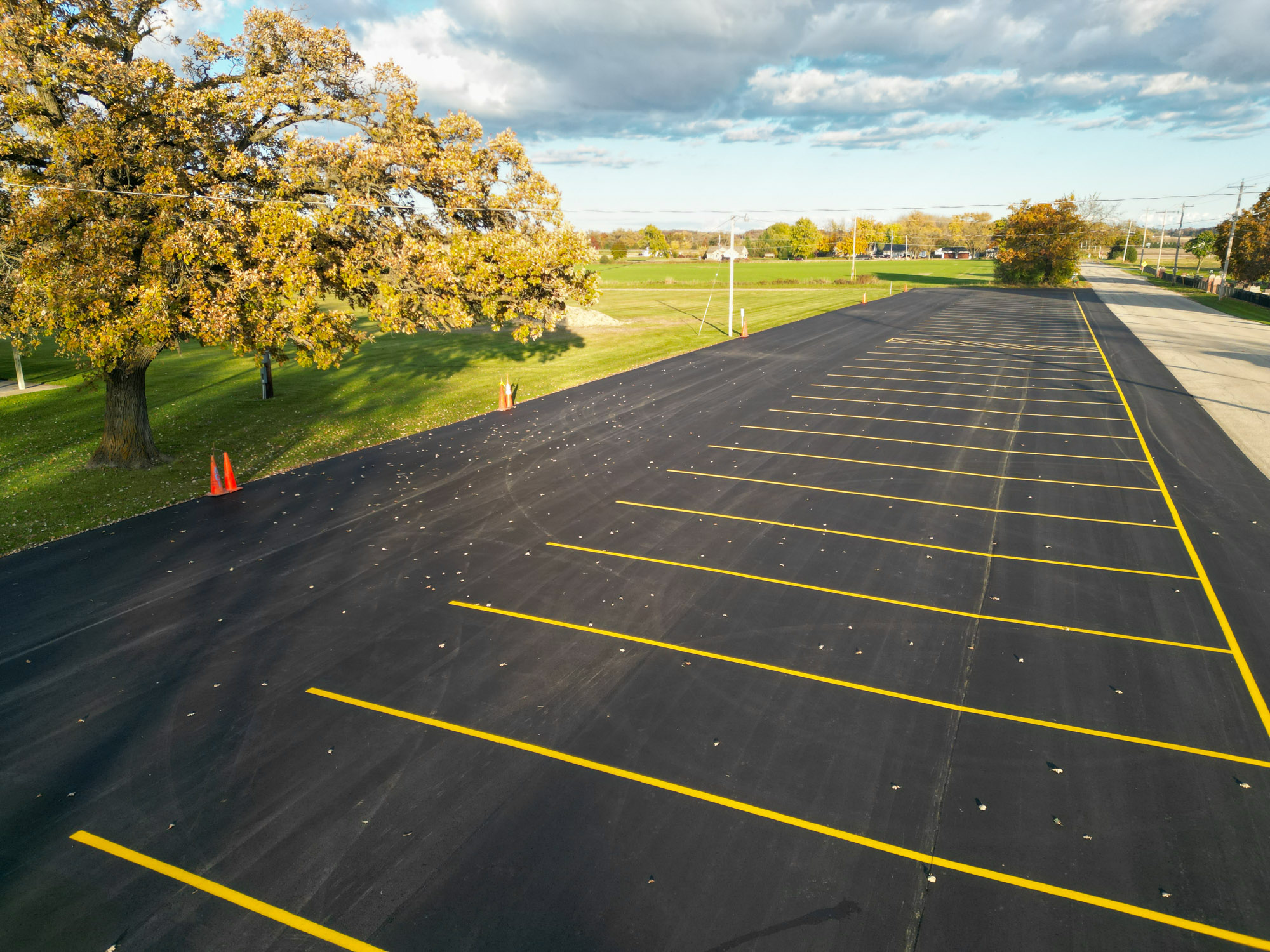
Lake Geneva's commercial corridor runs hard year-round. Resort complexes, marina properties, strip centers, and hospitality campuses along Geneva Lake generate heavy vehicle traffic across parking lots and access roads that can't afford downtime or premature failure. When a commercial asphalt paving project in Lake Geneva, WI is on your capital plan, the stakes are real: a well-built lot serves your tenants and guests for 20 or more years, while a poorly engineered one starts showing distress in five. Asphalt Contractors Inc. brings the equipment, mix design knowledge, and project management experience to handle large-scale commercial paving across Walworth County and the broader southeastern Wisconsin market.
This page covers the full scope of commercial paving services we provide to Lake Geneva property owners and managers: new parking lot construction, mill-and-overlay resurfacing, access road and private commercial drive work, sealcoating, and ADA-compliant striping. If you're evaluating contractors for an upcoming project, read on to understand what separates a properly engineered commercial installation from one that cuts corners on subbase preparation or mix spec.
Large-Scale Asphalt Paving Services for Lake Geneva Businesses & Properties
Lake Geneva isn't a quiet bedroom community. It's a destination economy. The area draws millions of visitors annually, and the commercial infrastructure supporting that traffic includes hotel campuses with oversized surface lots, waterfront retail blocks, conference centers, and multi-tenant commercial properties along Highway 50 and the surrounding corridors. Those properties share a common challenge: their paved surfaces take a beating from high volumes of passenger vehicles, delivery trucks, and seasonal maintenance equipment.
Asphalt Contractors Inc. works at the scale these properties require. We're not dispatching a two-person crew with a pickup and a plate compactor. Commercial projects in this market involve heavy grading equipment, asphalt pavers capable of laying wide, consistent mats, and rollers that achieve proper compaction across large surface areas. Getting that compaction right isn't optional; it's the difference between a lot that holds up through 40 freeze-thaw cycles and one that starts rutting in its second season.
Our commercial paving services cover the full project lifecycle, from site assessment and drainage planning through final striping. We work directly with property managers, ownership groups, and commercial general contractors on projects ranging from single-use retail lots to multi-phase resort property paving programs.
Businesses we regularly serve in the Lake Geneva area include:
- Hotel and resort properties requiring high-capacity surface parking
- Marina and waterfront commercial sites with mixed vehicle and trailer traffic
- Strip centers and neighborhood retail corridors
- Office and medical campuses
- Light industrial and distribution properties in the Walworth County area
- Municipal and quasi-public facilities requiring public-standard pavement specs
Parking Lot Construction & Replacement in Lake Geneva
New parking lot construction is the highest-stakes scope on this list. A full-depth installation on a commercial property is a six-figure capital commitment for most owners, and the decisions made during design and subbase preparation will determine whether that investment holds up for 20-plus years or starts failing prematurely.
Here's how a proper commercial parking lot installation works, from the ground up.
Subgrade evaluation and preparation. Before a single ton of aggregate goes down, the existing soil needs to be evaluated for bearing capacity. Weak or saturated subgrade is the number one cause of early pavement failure in Wisconsin. We excavate to the appropriate depth, address soft spots, and compact the native subgrade before any base material is placed.
Aggregate base installation. Commercial lots carrying standard passenger vehicle loads typically require a minimum of 6 to 8 inches of compacted crushed aggregate base. Lots that see regular delivery truck traffic, refuse haulers, or heavy equipment may spec 10 to 12 inches or more. The base layer is what transfers and distributes load; undersizing it to save money on the front end is one of the most expensive mistakes a property owner can make.
Drainage and grading design. Standing water is asphalt's worst enemy, especially in Wisconsin. Proper cross-slope grading (typically 2% minimum) and perimeter drainage structures ensure water moves off the surface and away from the pavement structure. We coordinate with civil engineers and site plans where required to make sure finished grades match the site's overall stormwater management design.
Asphalt depth and mix selection. Commercial lots typically receive a minimum of 3 inches of compacted asphalt in a binder and surface course combination. High-traffic or heavy-load areas may require 4 to 6 inches of total asphalt thickness. Mix design matters here too. Wisconsin winters demand asphalt mixes that are polymer-modified or otherwise engineered to resist low-temperature cracking while also standing up to summer softening under static loads.
Full lot replacement vs. new construction. If you have an existing lot that's beyond resurfacing, full-depth reclamation (FDR) is worth evaluating before you commit to complete removal and replacement. FDR pulverizes the existing asphalt and base material and reuses it as a stabilized base layer for the new pavement section, which can significantly reduce haul-away and material costs on large lots. We'll give you a straight comparison of costs and expected service life so you can make the call with real numbers in front of you.
See examples of completed commercial installations in our asphalt paving project portfolio.
Commercial Road Work & Private Drive Infrastructure
Not every paving need in the Lake Geneva commercial market fits neatly into the parking lot category. Resort campuses have internal access roads connecting lodging to amenities. Industrial and distribution properties have service lanes and loading dock aprons that carry repeated heavy truck loads. Larger commercial developments have entry drives and internal circulation roads that function more like private roadways than standard lot surfaces.
These applications require road-grade paving specs. That means thicker pavement sections, heavier aggregate base depths, and in many cases structural design that accounts for axle loads, turning radii for commercial vehicles, and long-term maintenance access for plows and sweepers.
We handle:
- Private access road construction and reconstruction for commercial campuses and resort properties
- Entry drive installation and replacement at retail and hospitality sites
- Service lane and loading dock apron paving
- Internal circulation roads for large commercial developments
- Asphalt work on commercial properties that connects to or meets WDOT-standard public road infrastructure
If your project involves work adjacent to or connecting with a public right-of-way, we're familiar with Wisconsin DOT standards and the permit coordination those projects require.
Understanding how commercial pavement performs over time helps property owners make smarter capital decisions. Our post on understanding asphalt lifespan and durability factors walks through the variables that most affect service life on commercial pavement.
Asphalt Resurfacing & Milling for High-Traffic Commercial Sites
Full replacement isn't always the right answer, and it's not always necessary. For commercial lots that have a structurally sound base but a surface layer that's deteriorated from traffic wear, oxidation, and freeze-thaw cycling, mill-and-overlay resurfacing is often the most cost-efficient path to a pavement that looks and performs like new.
How mill-and-overlay works. A cold milling machine grinds off the top 1.5 to 2 inches (or more, depending on the condition) of the existing asphalt surface. This removes cracking, rutting, and surface deterioration while leaving the underlying base structure intact. A new surface course of asphalt is then placed and compacted to the milled depth, restoring the surface profile and drainage grades. The result is a pavement that looks fresh and performs well, at a significantly lower cost than full removal and replacement.
When mill-and-overlay makes sense. It's the right call when the existing base is still structurally adequate, cracking is limited to the surface layer, and the pavement still has reasonable grades. It's not appropriate when the base has failed, when alligator cracking extends through the full pavement depth, or when drainage problems are causing subsurface moisture issues. Part of our pre-project assessment is evaluating your lot to tell you honestly which scenario you're in.
The cost difference can be substantial. On a typical commercial lot of 50,000 to 100,000 square feet, mill-and-overlay might run 40 to 60 percent of the cost of full reconstruction, making it the preferred choice when conditions allow.
Partial repairs and infrared patching. For lots that are mostly sound but have localized areas of failure, we can address problem zones with saw-cut removal and patch replacement or infrared asphalt repair before applying a surface treatment. This approach extends the overall lot life without the cost of a full resurfacing program.
Not sure whether your lot needs resurfacing or a lighter-touch maintenance treatment? Our resource on how to know when it's time to resurface vs. seal coat breaks down the decision criteria.
Sealcoating, Line Striping & Ongoing Lot Maintenance
A freshly paved commercial lot is an asset. Keeping it in good condition over its service life requires a maintenance program, not a set-it-and-forget-it approach. Asphalt Contractors Inc. provides the ongoing services that protect your pavement investment between major capital projects.
Commercial sealcoating. Sealcoating applies a protective coal-tar or asphalt-based emulsion coating over the pavement surface, blocking UV oxidation, water infiltration, and the softening effect of petroleum-based fluids (oil and fuel drips are common in parking areas). On a new commercial lot, a first sealcoat application is typically scheduled 12 to 18 months after installation, once the asphalt has fully cured. Reapplication on a 3- to 5-year cycle keeps the surface protected. The cost of regular sealcoating is a fraction of the cost of accelerated resurfacing caused by an unprotected surface.
Crack sealing. Cracks are asphalt's entry point for water. Once water gets into the pavement structure and reaches the base, freeze-thaw cycling turns small cracks into large failures fast. Routing and sealing cracks as part of an annual or biannual maintenance program is one of the highest-ROI activities available to a commercial property owner.
Line striping and ADA compliance. Every commercial lot needs clearly marked stalls, traffic lanes, fire lanes, and accessible parking spaces. Fresh striping improves traffic flow, reduces liability exposure, and keeps your property in compliance with ADA parking requirements. We handle ADA-compliant striping and parking lot safety marking as part of new installations and as a standalone service on existing lots. This includes accessible stall dimensions, access aisle widths, van-accessible designation, and the signage coordination required for full compliance.
For Lake Geneva commercial properties, the visual condition of your lot matters to guests and tenants alike. A well-maintained, cleanly striped surface communicates professionalism and care. Our article on how curb appeal affects your business goes deeper on the connection between pavement condition and commercial property perception.
Winter preparation. Wisconsin winters are hard on asphalt, and Lake Geneva properties with high visitor traffic need their lots ready before the first freeze. We work with property managers on pre-winter crack sealing and surface prep, and we coordinate with snow and ice management programs. Plowing and winter maintenance in Wisconsin require specific considerations for asphalt surfaces, particularly around plow blade clearance and deicing chemical compatibility.
Why Lake Geneva Property Managers Choose Asphalt Contractors Inc.
Commercial property managers evaluating paving contractors have a short list of real concerns: Will the crew show up on schedule? Will the finished product meet spec? Will the contractor stand behind the work when problems arise? And will the project get done without disrupting tenants, guests, or operations more than necessary?
Those are the right questions. Here's how we answer them.
Scale and equipment. We operate the heavy equipment that commercial-scale projects actually require. Paving a 200-stall resort parking lot or resurfacing an access road through an active commercial campus is a different job than small-scale work. Our crews are experienced with large, complex commercial sites and the logistics they involve.
Mix design and spec compliance. Asphalt Contractors Inc. is a member of the National Asphalt Pavement Association, which reflects our commitment to industry-standard practices in mix design, quality control, and project execution. We don't cut corners on aggregate base depth or asphalt thickness to win a bid.
Project management and communication. Commercial property managers don't have time to chase contractors for updates. We coordinate scheduling around your operational needs, communicate clearly at each project phase, and flag issues before they become surprises.
Regional knowledge. Southeastern Wisconsin has specific climate conditions, soil types, and freeze-thaw cycles that affect pavement design. We've been paving in this region long enough to know what works and what fails. That local knowledge shows up in how we spec projects and what we recommend.
You can review commercial project feedback directly: our commercial asphalt service review and parking lot asphalt services review reflect the experience of commercial clients who've worked with us on projects across southeastern Wisconsin.
Serving Walworth County & the Lake Geneva Commercial Corridor
Lake Geneva is our anchor in Walworth County, but our commercial paving work extends across the surrounding communities that make up this market. If your property is in Fontana-on-Geneva Lake, Williams Bay, Delavan, Elkhorn, or anywhere else in the county, we're already working in your area and can include your project in our scheduling rotation.
The commercial property mix across Walworth County is diverse. Along the Geneva Lake shoreline, we work with resort operators, waterfront dining facilities, and marina properties. Moving out toward Elkhorn and Delavan, the mix shifts to light industrial, agricultural supply, and municipal facilities. Each property type has its own traffic loading characteristics and maintenance priorities, and we adjust our approach accordingly.
Our broader southeastern Wisconsin service footprint includes Racine, Kenosha, and Milwaukee counties, which means we have the resources and crew capacity to service large-scale Lake Geneva projects without the limitations of a smaller regional contractor. For property managers overseeing multiple sites across southeastern Wisconsin, we can coordinate paving programs across locations to reduce mobilization costs and simplify contractor management.
Lake Geneva's tourism economy also creates a specific scheduling reality: many property owners prefer to complete major paving work during shoulder seasons (late fall or early spring) to avoid disrupting peak summer operations. We plan for that. Projects can be phased to keep critical traffic areas open during peak periods, and we're experienced with the kind of staging logistics that hospitality and resort properties require.
Get a Commercial Paving Quote for Your Lake Geneva Property
If you're planning a parking lot construction project, a resurfacing program, or any other commercial paving scope at a Lake Geneva property, the first step is a site visit and project assessment. We review the existing conditions, discuss your operational constraints and timeline, and put together a detailed quote that reflects actual project scope rather than a ballpark figure.
There's no obligation, and the assessment gives you the information you need to make a real capital decision: current condition of your pavement, what it will take to address it, what the work will cost, and what you can expect in terms of service life from the finished installation.
To request a quote, call us directly or fill out our contact form. We respond to commercial inquiries promptly and can typically schedule a site visit within a few business days.
- Service area: Lake Geneva, Walworth County, and southeastern Wisconsin
- Project minimums: We focus on commercial-scale work; contact us to discuss your specific scope
- Scheduling: We book projects on a first-confirmed basis; don't wait until the last minute if you have a season-sensitive timeline
Reach out through our commercial paving contact page or call to speak with someone directly about your Lake Geneva project.
Frequently Asked Questions
What types of commercial asphalt paving projects do you handle in Lake Geneva, WI?
We handle the full range of commercial-scale paving work in the Lake Geneva area: new parking lot construction from the subgrade up, mill-and-overlay resurfacing on existing lots, full-depth reclamation for lots beyond simple resurfacing, access road and private commercial drive installation, loading dock apron paving, and ongoing maintenance services including sealcoating, crack sealing, and line striping. We work with hotels, resort properties, marina facilities, retail centers, office campuses, and light industrial properties across Walworth County.
How long does a new commercial parking lot installation typically take?
Timeline depends heavily on lot size, site conditions, and how much earthwork or underground utility coordination is involved. A straightforward lot installation on a prepared site (grading and utilities already complete) might take 3 to 7 working days for a mid-size commercial lot. Larger lots or those requiring significant subgrade work, drainage installation, or phased construction to keep portions of the lot open during paving will take longer. We give you a realistic schedule during the quoting process, not an optimistic one.
What is the difference between asphalt resurfacing and full-depth reclamation for a commercial lot?
Mill-and-overlay resurfacing grinds off the deteriorated surface layer of the existing pavement and replaces it with new asphalt, leaving the base structure in place. It works when the base is still structurally sound and the problems are confined to the surface. Full-depth reclamation (FDR) pulverizes the entire existing pavement section, including the base material, and recycles it into a stabilized base layer for a completely new asphalt installation. FDR is the right call when the existing pavement structure has failed throughout, but it can be significantly more cost-effective than complete removal and replacement because the existing material stays on-site rather than being hauled away. We assess your specific lot conditions and give you a cost comparison for both approaches when either is a viable option.
How do Wisconsin winters affect commercial asphalt pavement, and how do you account for that in your mix design?
Wisconsin's freeze-thaw cycles are one of the most damaging forces acting on pavement. Water infiltrates cracks, freezes, expands, and widens the crack on every cycle. Subgrade moisture can freeze and cause frost heave that damages the pavement structure from below. We address this through several design decisions: proper drainage grading to move water off and away from the surface, adequate pavement thickness to keep the frost line below the base layer where possible, and asphalt mix specifications that include polymer modification to improve low-temperature flexibility and reduce thermal cracking. Crack sealing before winter is also a critical maintenance step that we recommend as part of every commercial maintenance program.
Do you handle ADA-compliant striping and accessibility features as part of a paving project?
Yes. ADA-compliant parking layout is part of every new lot installation and resurfacing project we complete. This includes proper accessible stall dimensions, access aisle widths, van-accessible space designation, and compliant slope grades within the accessible route. We can also provide standalone re-striping services on existing lots where the current layout doesn't meet current ADA standards or where fading has made existing striping unsafe. Correct accessible parking configuration is both a legal requirement and a liability issue for commercial property owners.
How do I get a commercial paving quote for my Lake Geneva property?
Contact us through our website or by phone to schedule a site visit. We'll come out to the property, evaluate the existing conditions, discuss your project goals and operational constraints (including any scheduling needs around peak business periods), and put together a detailed written quote. Commercial asphalt projects are priced based on actual scope: square footage, existing conditions, base requirements, mix specs, and any special considerations like phased construction or traffic control. We don't use vague ranges; you get a number you can actually budget against.
Commercial asphalt pavement in the Lake Geneva market is a long-term capital asset. Whether you're building a new parking lot for a resort expansion, resurfacing a retail center lot that's showing its age, or putting together a multi-year maintenance program for a commercial campus, the quality of the work done now determines what you'll spend on repairs over the next two decades. Asphalt Contractors Inc. brings the equipment capacity, technical depth, and regional experience to execute commercial paving projects in Lake Geneva and across Walworth County to a standard that holds up.
Ready to move forward? Contact Asphalt Contractors Inc. today to schedule your commercial site assessment and get a detailed quote for your Lake Geneva property. You can reach us through our commercial paving page or call directly. Paving season books fast in southeastern Wisconsin, so reach out early if your project has a seasonal deadline.