Waukesha County's commercial corridors handle serious traffic loads: semi-trucks cycling through distribution centers, forklifts crossing loading dock aprons, and hundreds of daily vehicle trips across retail and office park lots. When a surface fails under that kind of stress, the cost isn't just repair work. It's disrupted operations, liability exposure, and an asset that depreciates faster than it should. Asphalt Contractors Inc. is the commercial concrete paving contractor Waukesha WI businesses and property managers rely on for large-scale paving that holds up under real-world commercial conditions.
We handle concrete parking lot construction, access road paving, loading dock aprons, curb and gutter installation, commercial flatwork, and full concrete replacement at a scale suited to industrial facilities, institutional campuses, and municipal projects throughout Waukesha and southeastern Wisconsin. If your project requires engineered subbase work, ADA-compliant surfaces, or phased pours coordinated around active tenants, we can manage it start to finish without subcontracting the core work.
Commercial Concrete Paving Services We Offer in Waukesha
Our commercial concrete work covers the full range of surfaces a Waukesha-area property needs to function reliably over a 30-year asset horizon. Every project starts with the right engineering decisions, not just a pour date.
- Concrete Parking Lot Construction: Full-depth concrete parking lots designed for high-volume vehicle traffic, including mix design, subbase preparation, joint planning, and surface finishing. We size reinforcement and slab thickness to the expected load profile, whether that's a 300-stall office park or a distribution center with daily semi activity.
- Concrete Roadways and Access Drives: Private roadways, access drives, and truck courts for industrial and commercial properties across Waukesha County. We coordinate with Wisconsin DOT standards on projects that connect to public rights-of-way.
- Loading Dock Aprons: High-stress concrete aprons engineered for repeated forklift and semi-truck loading cycles. Slab thickness and joint placement are critical here; undersized flatwork fails quickly under impact loads.
- Curb and Gutter: Cast-in-place concrete curb and gutter for stormwater control, lot definition, and ADA compliance. We match existing grades and drainage patterns or work from new civil drawings.
- Commercial Concrete Flatwork: Equipment pads, dumpster enclosures, sidewalks, plaza surfaces, and other concrete flatwork at commercial scale. ADA-compliant ramps and accessible routes are included where required by code.
- Concrete Repair and Replacement: Full-depth panel replacement, joint repair, and slab stabilization for existing concrete surfaces that are cracking, settling, or failing. We assess whether repair or full replacement delivers better cost-per-year value before recommending either.
All work is performed by our own crews. We don't broker these projects to third-party subcontractors, which keeps quality control, scheduling accountability, and communication in one place for the property managers and owners we work with.
Why Waukesha Commercial Property Owners Choose Concrete Paving
The decision to pave in concrete rather than asphalt is primarily a financial and operational one. For commercial property owners managing assets over a 20-to-30-year horizon, concrete's total cost of ownership is typically lower despite the higher upfront cost per square foot.
Load-bearing capacity. A properly designed concrete slab handles heavy commercial traffic in ways that asphalt simply can't match without constant maintenance. A standard 6-inch reinforced concrete slab can support repeated axle loads from semi-trucks and heavy equipment without rutting, shoving, or surface deformation. Asphalt under the same loading requires a more robust base and periodic resurfacing to maintain structural integrity. For warehouse and distribution properties on Waukesha County's industrial corridors, that load capacity isn't optional.
Reduced long-term maintenance cost. Asphalt requires sealcoating every 3-5 years and resurfacing on a 15-20 year cycle under normal commercial traffic. A concrete surface installed correctly in Wisconsin's climate requires significantly less cyclical maintenance. You're not budgeting for annual sealcoat applications or planning resurfacing projects around tenant leases.
Freeze-thaw durability. Southeastern Wisconsin averages more than 40 freeze-thaw cycles per year. Properly air-entrained concrete, using a mix with 5-7% air content, resists freeze-thaw scaling and cracking far better than inadequately specified mixes. We use concrete mixes designed for Wisconsin's exposure conditions, not generic specs.
Surface brightness. Concrete's lighter color reduces heat island effect in large parking areas and can meaningfully reduce lighting costs for property owners managing evening operations. Some municipalities in Waukesha County factor this into stormwater and sustainability requirements for new commercial development.
For property owners evaluating long-term pavement investments, this resource on commercial concrete paving as a sustainable choice for Milwaukee businesses covers the environmental and lifecycle angle in more depth.
Concrete vs. Asphalt: Choosing the Right Surface for Your Commercial Property
This isn't a sales pitch for one material over the other. Both concrete and asphalt are legitimate choices for commercial paving in Waukesha, and the right answer depends on your project's specific traffic loads, budget structure, and operational timeline. Asphalt Contractors Inc. installs both, so you're getting an honest assessment rather than a contractor pushing you toward the product they only know how to sell.
Here's how the key decision factors break down for commercial buyers:
- Upfront cost: Asphalt typically costs less per square foot to install than concrete. For projects where capital budget is the binding constraint, asphalt may make more sense even if the lifecycle cost is higher.
- Long-term maintenance: Concrete requires less frequent maintenance spend over a 25-30 year period. Asphalt requires sealcoating, crack filling, and eventual resurfacing on predictable cycles.
- Heavy load performance: Concrete outperforms asphalt under concentrated heavy loads, making it the preferred choice for loading dock aprons, truck courts, and high-frequency delivery areas.
- Repair flexibility: Asphalt repairs are faster and easier to blend visually. Concrete panel replacement is more involved but addresses structural failure rather than just surface appearance.
- Repaving disruption: Asphalt resurfacing can be phased and completed quickly. Full concrete replacement takes longer and requires more cure time before the surface opens to traffic.
- Wisconsin climate: Both materials perform well in southeastern Wisconsin when properly specified and installed. The key variable is mix design and subbase quality, not material choice alone.
For a detailed side-by-side comparison built for commercial property decisions, see our full guide: Concrete vs. Asphalt: Making the Right Choice for Your Milwaukee Commercial Spaces. And if your project scope spans both materials, our Milwaukee commercial asphalt services are available alongside our concrete work so you don't need separate contractors for each surface type.
Our Commercial Concrete Paving Process: What to Expect
Large commercial concrete projects involve more moving parts than most property managers anticipate the first time through. Here's how we sequence the work and what we communicate at each phase.
- Site Assessment and Engineering Review: Before any equipment arrives, we assess existing subgrade conditions, drainage patterns, and load requirements. If civil drawings exist, we review them. If they don't, we can work with your engineer or recommend one. We identify soil bearing capacity issues at this stage so they don't become change orders mid-project.
- Subbase Preparation: A concrete slab is only as good as what's beneath it. We excavate to the specified depth, import and compact granular base material to the required density, and verify grade before forming begins. Compaction testing is available on projects where the owner or engineer requires documented QC.
- Forming: We set forms to grade for each pour section, accounting for expansion and contraction joints at appropriate intervals for the slab dimensions and anticipated temperature range. Joint placement is a design decision, not an afterthought.
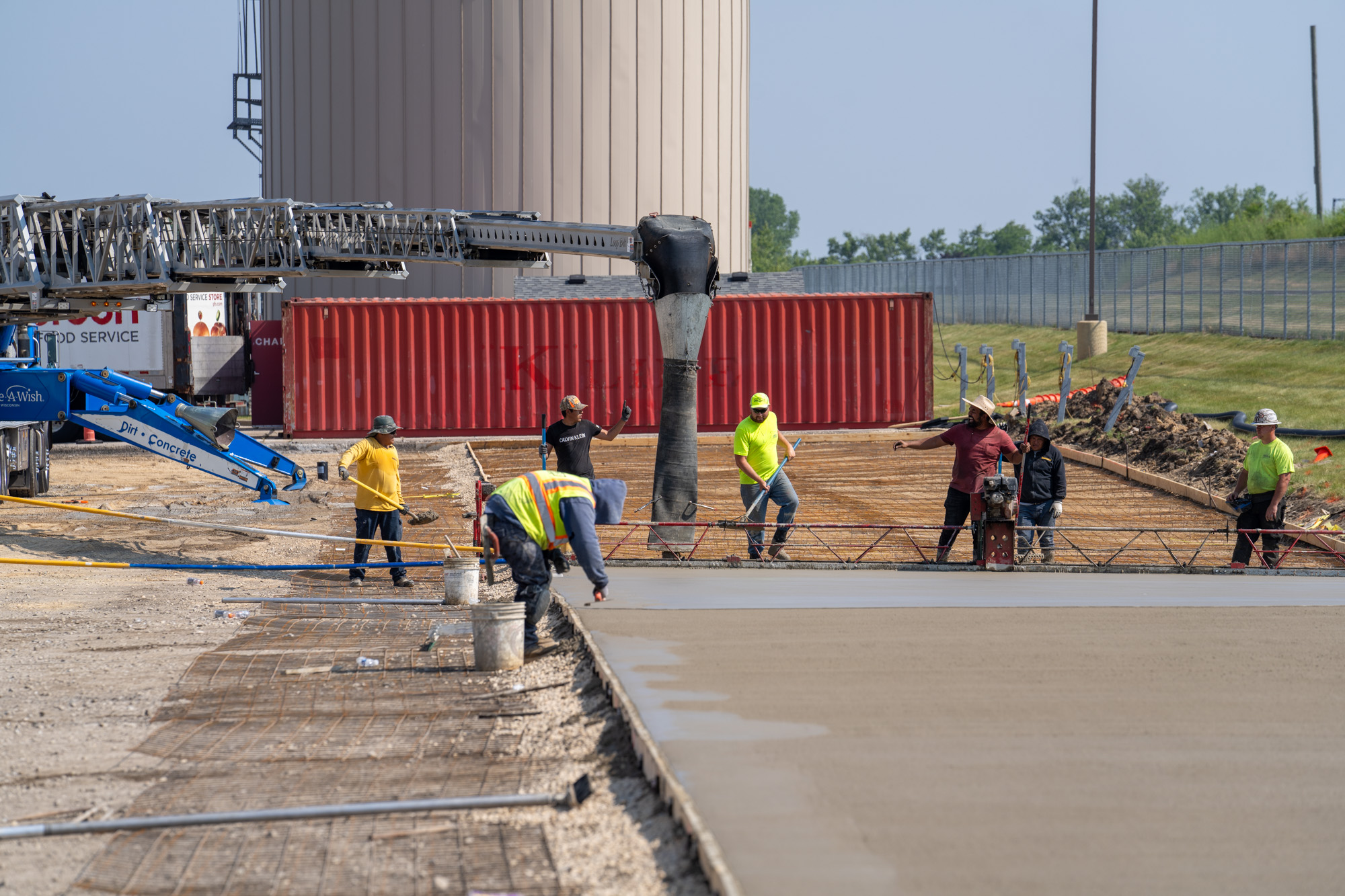
- Concrete Pour and Finishing: We coordinate concrete delivery to match pour capacity, avoiding cold joints from delayed trucks. Finishing method (broom finish, exposed aggregate, or smooth) is specified in advance based on the surface's traction requirements and aesthetic criteria.
- Curing: Concrete in Wisconsin's variable climate requires careful curing. We apply curing compound or wet-cure methods depending on ambient temperature and humidity at pour time. In cooler weather, we use insulated blankets to maintain slab temperature within spec during the critical first 24-72 hours.
- Joint Sawing and Sealing: Control joints are saw-cut at the specified intervals within the cure window, then cleaned and sealed with an appropriate joint sealant for the traffic and climate exposure.
- Final Inspection and Turnover: We walk the completed surface with the property manager or owner before signing off. We document joint locations, mix design records, and pour dates so you have the project file for future reference.
For commercial properties with active tenants or operations running adjacent to the work zone, we build a phased access plan into the project schedule from the start. You'll know which areas are closed and for how long before the first truck arrives on site.
Industries and Property Types We Serve in the Waukesha Area
Our commercial concrete work spans a wide range of property types across Waukesha County and the broader southeastern Wisconsin market. The common thread is scale: these are projects where surface performance directly affects business operations or public use.
- Warehousing and Distribution: Truck courts, loading dock aprons, and interior access drives for distribution centers and logistics facilities. Waukesha County's position along I-94 and US-18 makes it a dense corridor for this property type.
- Industrial Facilities: Manufacturing plants and industrial campuses with heavy equipment staging areas, forklift paths, and chemical-resistant surface requirements. We specify concrete mixes and sealers appropriate to the operational environment.
- Retail Strip Centers and Commercial Plazas: Parking fields, drive aisles, pedestrian walks, and ADA-compliant accessible routes for multi-tenant retail properties. Surface appearance matters here in addition to durability.
- Office Parks: Large parking structures and surface lots for multi-building office campuses. Concrete's lower maintenance profile reduces the ongoing facility management burden for property managers with large surface areas to maintain.
- Municipal Projects: Public roadways, municipal facility lots, and infrastructure projects for local government entities in Waukesha County. We're familiar with the documentation and bonding requirements that public sector procurement typically requires.
- Institutional Campuses: Schools, healthcare facilities, and religious institution campuses with a mix of pedestrian and vehicle traffic, accessible route requirements, and scheduled construction windows that can't disrupt operations during the school year or patient care hours.
If your industry isn't listed here, that doesn't mean we haven't done the work. The paving requirements for a self-storage facility or a car dealership lot are different from a distribution center, but the underlying engineering principles are the same. A well-graded, properly reinforced concrete surface performs across all of them.
For more on how concrete paving affects commercial curb appeal and tenant retention, see: How Commercial Concrete Contractors in Milwaukee Can Enhance Your Business's Curb Appeal. And for the business case on pavement quality as a property value driver, this post on curb appeal and how it can affect your business is worth a read.
What Sets Our Concrete Contractors Apart in Waukesha, WI
Property managers and procurement teams evaluating concrete paving contractors ask the same core questions: Can they handle a project this size? Do they self-perform? Are they properly bonded and insured? Here's where we stand on each of those.
Self-performance on core work. We don't broker commercial concrete projects to subcontractors. Our own crews perform the subbase prep, forming, pour, and finishing. That matters for quality control and it matters for schedule accountability. When something needs to change on a Wednesday afternoon, the decision-maker is reachable, not three phone calls away at a sub's office.
Scale experience. We've completed commercial paving projects across southeastern Wisconsin ranging from single-phase parking lot builds to multi-phase industrial site work coordinated around active facility operations. Large projects require different project management than small ones. Phased closures, traffic control plans, concrete delivery sequencing, and cure-window management all require experience at scale to execute without disrupting your tenants or operations.
Bonded and insured. We carry the bonding and insurance coverage that commercial property owners and public sector procurement require. If your contract or your lender's requirements specify coverage minimums, we can provide documentation during the bidding process.
Wisconsin contractor credentials. We operate under Wisconsin's contractor licensing requirements and are familiar with local permitting processes in Waukesha County municipalities. On projects adjacent to public rights-of-way, we coordinate with the relevant municipal engineering departments and the Wisconsin Department of Transportation as needed.
Mix design accountability. We specify concrete mixes appropriate to Wisconsin's exposure conditions: air entrainment for freeze-thaw resistance, appropriate water-cement ratios for the target compressive strength, and admixtures when ambient temperature conditions require them. You'll receive mix design records and batch tickets on projects where documentation is required.
For additional reading on what goes into durable commercial concrete surfaces in this region, see: Unlocking the Secrets of Long-lasting Commercial Concrete Paving in Milwaukee.
Frequently Asked Questions About Commercial Concrete Paving in Waukesha
The following questions come directly from commercial property owners and managers we work with across Waukesha County and southeastern Wisconsin. If your question isn't answered here, contact us directly for a project-specific conversation.
Request a Commercial Concrete Paving Quote in Waukesha
If you're managing a commercial paving project in Waukesha or anywhere across southeastern Wisconsin, the next step is a site visit and a written quote scoped to your actual project conditions. We don't do ballpark estimates over the phone for large commercial work because the variables that drive cost (subgrade condition, drainage requirements, existing surface removal, phasing constraints) aren't visible without a site assessment.
Contact Asphalt Contractors Inc. to schedule a site visit. We serve Waukesha County, Milwaukee County, Racine County, Kenosha County, and the broader southeastern Wisconsin commercial market. Once your concrete surface is installed, don't overlook the value of proper pavement striping for safety and ADA compliance as a logical next step after project completion.
Frequently Asked Questions
What types of commercial concrete paving projects do you handle in Waukesha, WI?
We handle the full range of commercial-scale concrete work: parking lot construction, private roadways and access drives, loading dock aprons, truck courts, curb and gutter installation, concrete flatwork for equipment pads and commercial plazas, ADA-compliant accessible routes, and full concrete panel replacement or repair on existing surfaces. We don't take on residential driveway work; our crews and project management capacity are sized for commercial and municipal-scale projects. If your project is in Waukesha County or the surrounding southeastern Wisconsin area and involves commercial concrete, we can assess it.
How long does a large-scale commercial concrete paving project typically take?
Timeline depends on the project's square footage, number of pour phases, cure requirements, and site access constraints. A single-phase concrete parking lot of 20,000-40,000 square feet might run 3-5 weeks from mobilization to final walkthrough, accounting for subbase work, forming, pour, cure time, and joint sealing. Multi-phase projects coordinated around active tenants or operations take longer by design since we're sequencing pours around your business hours or access restrictions. Cure time is non-negotiable: concrete needs a minimum of 7 days before light vehicle traffic and 28 days to reach full design strength under heavy loads. We build those windows into the schedule upfront so they don't come as a surprise.
What is the expected lifespan of a commercial concrete surface compared to asphalt?
A properly designed and installed commercial concrete surface in Wisconsin's climate typically performs for 30-40 years with routine joint maintenance. Asphalt under similar commercial traffic conditions generally requires resurfacing at the 15-20 year mark and sealcoating every 3-5 years throughout its life. The upfront cost of concrete is higher per square foot, but the total cost of ownership over a 30-year period is usually lower when you account for asphalt's cyclical maintenance costs. The exact comparison depends on traffic volume, load type, and the quality of the original installation. Concrete installed with the wrong mix design or inadequate subbase will fail early regardless of the material's theoretical lifespan. For more detail on lifespan factors, the Portland Cement Association's resources on commercial concrete are a useful reference.
Do you handle permitting and engineering coordination for commercial projects in Waukesha?
Yes. We coordinate permitting with Waukesha County municipalities and relevant state agencies for projects that require it, including work adjacent to public rights-of-way or in areas with stormwater management requirements. For projects that require stamped engineering drawings, we work with the property owner's engineer of record or can refer you to qualified civil engineers we've worked with on prior projects. On Wisconsin DOT-adjacent work, we're familiar with the submittal and coordination process. We don't assume permitting is someone else's problem; if it affects your project timeline, we're involved in getting it resolved.
Can you pour concrete in Wisconsin's cold-weather season, or is there a seasonal cutoff?
Cold-weather concrete placement is possible in Wisconsin but requires specific precautions that not every contractor takes seriously. When ambient temperatures are below 40°F or expected to drop below 40°F within 24 hours of the pour, ACI 306 guidelines require measures to protect the concrete during the critical early cure period: heated enclosures, insulated curing blankets, or heated mixing water to maintain the slab temperature above 50°F for at least 7 days. We follow those protocols on cold-weather pours. That said, there are temperature thresholds where the cost and complexity of cold-weather protection make it more practical to schedule the pour for spring. We'll give you an honest assessment of whether a late-season pour is feasible for your project rather than just taking the job and hoping for warm weather.
How is pricing structured for commercial concrete paving — per square foot, or by project scope?
We quote commercial concrete projects by project scope rather than a simple per-square-foot rate, because the variables that drive cost are too significant to flatten into a single number. Subgrade condition, depth of excavation required, thickness and reinforcement of the slab, mix design requirements, site access constraints, phasing requirements, removal and disposal of existing pavement, and ADA compliance work all affect the final number independently of square footage. A 10,000-square-foot apron with poor subgrade and a tight delivery window costs differently than a 10,000-square-foot apron on a clean site with open access. We provide written, itemized quotes after a site visit so you know exactly what you're paying for and why.
Asphalt Contractors Inc. is a commercial concrete paving contractor serving Waukesha, WI and the full southeastern Wisconsin market, including Waukesha County, Milwaukee County, Racine County, and Kenosha County. Whether your project is a new parking lot build, a loading dock apron replacement, or a phased concrete road reconstruction around active facility operations, we have the crew capacity, project management experience, and technical depth to deliver it. Contact us to schedule a site visit and receive a written project quote scoped to your actual conditions.