Concrete flatwork failures don't announce themselves ahead of schedule. A loading dock apron that starts spalling under forklift traffic, an ADA path that heaves after two Wisconsin winters, a fire lane slab that develops joint separation nobody noticed until a city inspector did — these are the problems that land on a property manager's desk without warning, and they require a contractor with the scale and local knowledge to fix them right. As a commercial concrete flatwork contractor in Racine, WI, Asphalt Contractors Inc. has been handling exactly these situations for commercial property owners across southeastern Wisconsin for years.
This page covers what commercial flatwork actually involves at scale, which applications we handle, how the process works from site assessment through final inspection, and how to tell when your existing concrete has reached the end of its service life. If you're evaluating contractors right now, the details below will help you ask the right questions — of us or anyone else you're considering. Good concrete work is a 20-to-30-year asset when it's done properly. It's worth understanding what that process looks like before the first truck arrives on site.
What Is Commercial Concrete Flatwork — and Why Does It Matter for Your Property?
Flatwork is the category of concrete construction that covers horizontal, poured-in-place surfaces at or near grade. Sidewalks, equipment pads, loading dock slabs, plaza surfaces, fire lane aprons — all of it falls under flatwork. The term distinguishes these horizontal pours from vertical concrete work like walls, columns, and foundations.
At a residential scale, flatwork is relatively forgiving. A standard mix, a properly compacted base, and decent finishing technique will produce a surface that holds up for decades under foot traffic and passenger vehicles. Commercial flatwork is a different problem entirely.
The variables multiply fast. A distribution facility loading dock might absorb the weight of a loaded semi-trailer repeatedly, every day. An exterior equipment pad might support a generator or HVAC unit weighing several tons. A fire lane has to meet code load requirements for emergency apparatus. Each application demands a specific concrete mix design, a minimum slab thickness, reinforcement strategy, and a subbase engineered for that load. Get any one of those factors wrong and the surface fails — not in 30 years, but in 3.
Material selection matters at this scale too. The Portland Cement Association's guidance on flatwork outlines the critical role that water-cement ratio, air entrainment, and curing time play in freeze-thaw durability. In Racine County, where surface temperatures swing dramatically between seasons, those aren't academic details. They're the difference between a slab that lasts 25 years and one that starts scaling after the first winter deicing cycle.
Subbase preparation is equally non-negotiable. Settlement cracks in commercial concrete almost always trace back to inadequate compaction or improper base depth — not to the concrete itself. A contractor who skips the geotechnical groundwork is cutting a corner you'll pay for later. At Asphalt Contractors Inc., subbase grading and compaction are treated as primary work, not a formality before the pour.
Commercial Flatwork Applications We Handle in Racine
The range of commercial concrete flatwork we install in Racine and across southeastern Wisconsin covers most of what a property manager or facilities director is likely to encounter. Specific applications include:
- Loading dock slabs and aprons: Designed for repeated heavy-axle loads, these require thicker sections (typically 8 to 12 inches), heavy reinforcement, and tight joint placement to prevent edge cracking.
- Equipment pads: Concrete pads for rooftop mechanical units, generators, transformers, and industrial equipment. Pad dimensions and thickness are engineered to the specific equipment load and footprint.
- Fire lane aprons and drive surfaces: Must meet local code requirements for emergency vehicle loading, typically 75,000 lbs or more. Fire lane concrete is generally thicker than standard pedestrian flatwork and requires specific finish textures for traction.
- ADA-accessible exterior walkways and paths: Connecting buildings, parking areas, and building entrances in compliance with ADA slope, width, and surface requirements. We coordinate with site grades to ensure proper drainage without creating cross-slope violations.
- Commercial entryways and vestibule aprons: High-traffic entry pads that need to hold up to constant foot traffic, cart wheels, and heavy service deliveries.
- Dumpster pads and enclosure slabs: Reinforced slabs designed to handle the point loads from waste hauler trucks lifting and setting containers repeatedly.
- Courtyard and plaza surfaces: Large decorative or functional exterior slabs for corporate campuses, retail centers, and mixed-use developments where appearance and durability both matter.
- Curb-and-gutter tie-ins: Concrete flatwork that integrates with existing or new curb and gutter systems, requiring careful grade matching and joint detailing.
- Utility vault and manhole surrounds: Replacement and new concrete work around buried infrastructure access points in commercial yards and drive lanes.
If your project doesn't fit neatly into one of these categories, that's fine too. Commercial sites don't always follow a template, and neither does our work. Commercial concrete work at this scale can also significantly improve a property's curb appeal and overall site presentation, which matters for tenant retention and property value.
Why Racine Property Owners Choose Asphalt Contractors Inc. for Concrete Flatwork
There's no shortage of contractors who will pour concrete. What's harder to find is a crew that shows up with the equipment, crew size, and local experience to handle a 5,000-square-foot industrial slab or a multi-phase commercial campus project without losing control of the schedule.
Here's what distinguishes our operation for commercial clients in Racine County:
Scale and crew capacity. Commercial flatwork projects move fast once the pour begins. A finishing crew that's too small for the square footage will struggle to keep up with the concrete before it sets, and that leads to surface defects that can't be corrected after the fact. We size our crews to the project, not the other way around.
Regional experience that actually applies. We've been working commercial sites in Racine, Sturtevant, Mount Pleasant, and surrounding communities long enough to know the local soil conditions, the frost depth challenges, the permit processes at the county level, and the seasonal timing windows that make or break a project's schedule. That local knowledge isn't something you can substitute with generic experience elsewhere.
Quality control on mix design and finishing. We specify concrete mixes to the application. A pedestrian walkway at a corporate office doesn't need the same mix as a forklift aisle in a cold-storage warehouse. We work with ready-mix suppliers to hit the right compressive strength, air content, and slump for each pour, and we monitor batch tickets on-site to confirm delivery matches spec.
Trade coordination on larger projects. Commercial flatwork rarely happens in isolation. Site work, utility installation, building construction, and landscaping all intersect. We're experienced at sequencing our work around other trades and coordinating with general contractors and project managers to keep the overall schedule on track.
Clients who've worked with us on commercial projects in Racine speak to the consistency of that experience. Read what Jeane Ritow from Racine had to say about working with our team as one data point from a local client perspective.
The Commercial Concrete Flatwork Process: From Site Assessment to Final Pour
Understanding our process helps you plan around it. Here's how a typical commercial concrete flatwork project moves from initial contact to a surface you can put into service.
- Site evaluation and scope definition. We start on-site, not over the phone. We walk the area, evaluate existing conditions, check grades and drainage patterns, identify underground utilities, and discuss the intended use of the surface. This is where load requirements, slab thickness, and reinforcement strategy get established. A loading dock apron is a different engineering conversation than an exterior pedestrian walkway.
- Subbase grading and compaction. This is the most important step and the one most often done inadequately on projects that later fail. We excavate to the required depth, import or redistribute base aggregate as needed, and compact in lifts to achieve proper density. We use compaction testing where specifications require it. No pour happens until the base is ready.
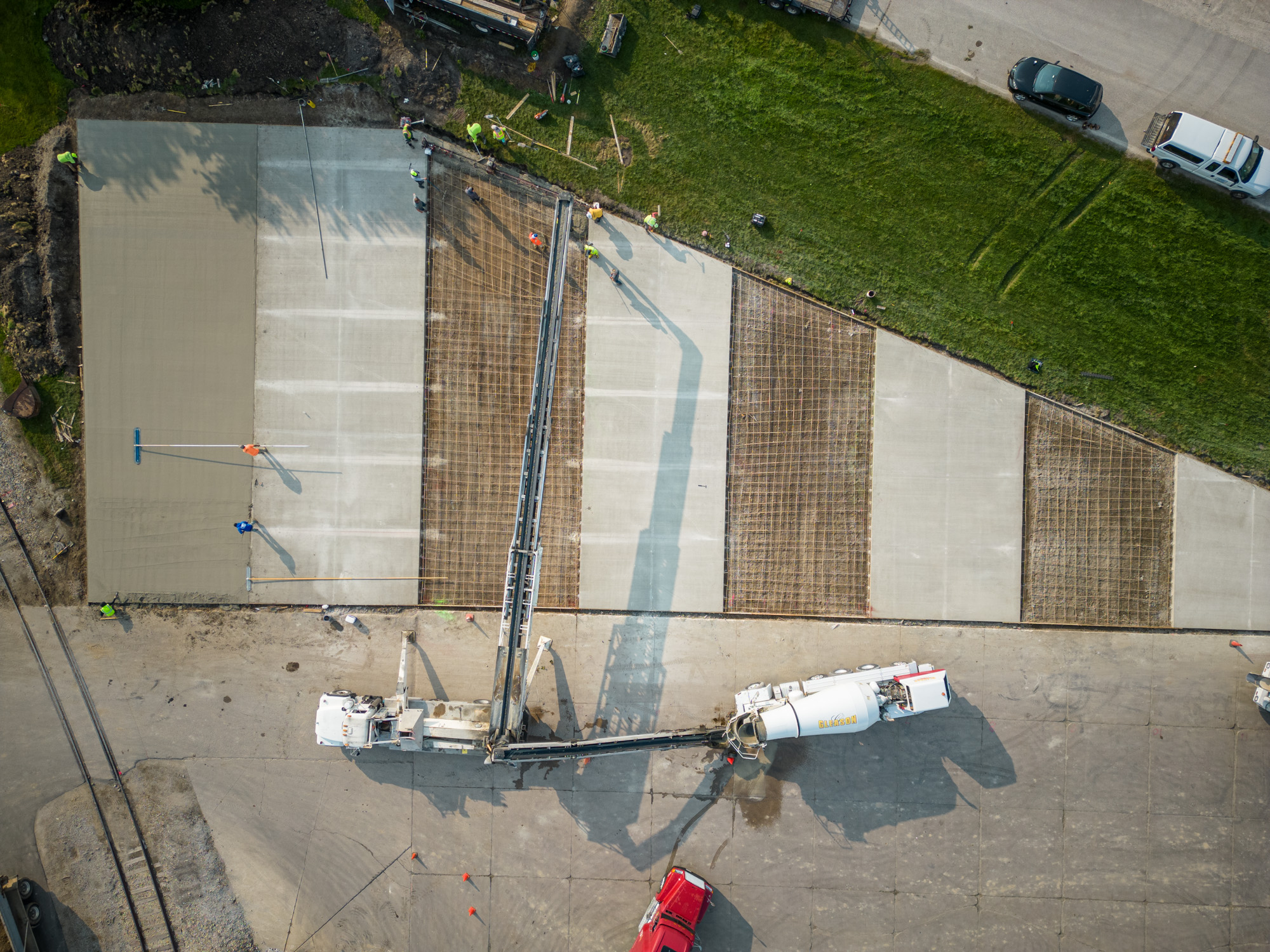
- Form setting. Forms define the geometry of the slab and establish the final surface elevation. On larger pours, laser-guided screed equipment replaces traditional edge forms for large interior areas, improving flatness tolerances significantly.
- Concrete mix selection and ordering. We specify the mix design based on the application: compressive strength (typically 4,000 to 5,000 psi for commercial flatwork), air content for freeze-thaw exposure, fiber or rebar reinforcement, and admixtures as needed. Batch tickets are reviewed on delivery.
- Pour and finishing. Concrete is placed, consolidated, screeded to grade, and finished to the specified surface texture. Commercial flatwork finishing varies by application: broom finish for exterior pedestrian surfaces, smooth trowel finish for interior slabs, exposed aggregate or other treatments for plaza surfaces.
- Curing. Proper curing is non-negotiable in Wisconsin's climate. We apply curing compound or wet-cure methods to control moisture loss, especially critical during warm or windy conditions that accelerate surface drying and can cause plastic shrinkage cracking.
- Joint cutting. Control joints are saw-cut within the appropriate window after placement to direct shrinkage cracking to planned locations. Joint spacing and depth are calculated based on slab thickness and aggregate size. Skipping or delaying joint cutting is a common cause of uncontrolled random cracking.
- Final inspection and traffic release. We conduct a final walkthrough before releasing the surface for use, and we communicate clearly about when foot traffic, light vehicle traffic, and heavy equipment can return to the area based on the curing timeline.
Concrete vs. Asphalt for Commercial Flatwork: Choosing the Right Surface
As a contractor that installs both asphalt and concrete at commercial scale, we don't have a stake in steering you toward one or the other. The right answer depends on your site, your use case, and your operational priorities. Here's a straightforward breakdown.
When concrete tends to be the better choice:
- High-load applications where surface deformation under point loads is a concern. Concrete's rigidity distributes load differently than flexible asphalt, making it preferable under forklifts, heavy equipment, and loading dock traffic.
- Areas exposed to petroleum products, oils, or chemicals. Asphalt is petroleum-based and can soften or deteriorate under fuel spills. Concrete holds up significantly better in these environments.
- Aesthetic plaza and courtyard surfaces where appearance, finish variety, or decorative options matter to the property presentation.
- Applications with a long ownership horizon and a preference for reduced maintenance. Concrete generally requires less ongoing maintenance than asphalt, though repairs when needed are more disruptive and expensive.
- Interior slabs within buildings or covered structures, where asphalt is almost never the appropriate material.
When asphalt may be the better choice:
- Large parking field areas where upfront cost per square foot is a primary driver and the surface can be maintained with periodic sealcoating and crack filling.
- Projects where fast return-to-service is critical. Asphalt can typically be opened to traffic within 24 to 48 hours; concrete requires a longer curing period before heavy loads.
- Sites where future utility work or grade changes are anticipated, since asphalt is easier to cut, patch, and resurface than concrete.
For a detailed side-by-side analysis of both materials in a commercial context, our concrete vs. asphalt comparison for Milwaukee commercial spaces covers the tradeoffs in more depth. Many of our Racine commercial projects actually involve both materials on the same site, each assigned to the application it suits best.
Signs Your Commercial Concrete Flatwork Needs Replacement or Repair
Not every concrete problem requires a full replacement. But several failure modes common to commercial sites do signal that repair has passed its cost-effectiveness window, and continuing to patch is just deferring a larger project at higher cost.
Spalling under forklift or heavy vehicle traffic. Surface spalling that exposes aggregate and creates an uneven running surface is both a safety and a material issue. In high-traffic aisles and dock areas, spalled concrete accelerates vehicle wear and creates trip hazards. If spalling covers more than roughly 25 to 30 percent of a surface area, full replacement typically makes more financial sense than repeated patching.
Heaving from freeze-thaw cycles. Wisconsin's freeze-thaw cycle is aggressive. When moisture infiltrates beneath a slab and freezes, the resulting expansion pushes concrete upward. Repeated cycles cause progressive heave that can't be corrected by surface repair. The underlying drainage or subbase issue has to be addressed as part of any lasting fix.
Joint failure and faulting. When adjacent slab panels settle at different rates, the edges at control joints develop a vertical offset called faulting. This creates an abrupt edge that damages equipment tires, creates trip hazards for pedestrians, and signals subbase movement that won't self-correct.
Surface scaling from deicing chemicals. Chloride-based deicers attack concrete surfaces, particularly concrete that wasn't properly air-entrained during placement or that was deiced during the first winter before adequate strength development. Scaling appears as a flaky, pitted surface and progressively exposes aggregate.
Structural cracking with displacement. Not all cracks are equal. Hairline cracks that remain level and stable are often manageable with routing and sealing. Cracks where the two sides have shifted vertically or horizontally, or where crack width exceeds a quarter inch, indicate structural movement that sealing won't address.
If you're seeing any of these conditions at your Racine facility, this guide on when to invest in professional concrete services for Racine businesses provides additional context for evaluating your options. For perspective on what commercial concrete repair looks like before it reaches replacement territory, our overview of commercial concrete repair for West Allis business owners covers the repair-vs-replace decision in detail.
Serving Racine County and Southeastern Wisconsin
Our commercial concrete flatwork work is concentrated in Racine County and the surrounding region. We regularly serve clients in Racine, Sturtevant, Mount Pleasant, Caledonia, and Wind Point. Our location gives us practical access to commercial and industrial sites throughout Kenosha County to the south and Milwaukee County to the north, making us a realistic option for property managers with multi-site portfolios across southeastern Wisconsin.
If your project is in the broader region and you're not sure whether we cover your location, contact us directly. We work across a wide service area and will tell you honestly if a project falls outside our range.
For context on the scope of commercial paving and concrete work we handle across the region, see our Milwaukee commercial asphalt services overview.
Request a Commercial Concrete Flatwork Estimate in Racine
We offer free on-site estimates for commercial concrete flatwork projects in Racine and across southeastern Wisconsin. On-site is the key phrase: we don't quote commercial slab work from photos or square-footage estimates submitted online. The site conditions, subbase situation, drainage, and access all affect the scope, and we need to see them in person to give you a number you can actually plan around.
Response time matters on commercial projects. We prioritize commercial clients and work to schedule site visits quickly so your project planning doesn't stall waiting on contractor availability. Our team handles projects across the full range of commercial scale, from a single equipment pad to multi-phase site development requiring phased concrete installation.
To schedule your estimate, call us directly or use the contact form on this site. Be ready to share basic project details: the location, the intended use of the surface, an approximate square footage if you have it, and any deadline constraints. That information helps us send the right crew lead for the initial visit.
Frequently Asked Questions
What types of commercial concrete flatwork does Asphalt Contractors Inc. install in Racine?
We install a wide range of commercial concrete flatwork in Racine County, including loading dock slabs and aprons, heavy equipment pads, fire lane surfaces, ADA-accessible exterior walkways, commercial entryways, dumpster pads, courtyard and plaza surfaces, curb-and-gutter tie-ins, and utility vault surrounds. Each application is engineered to the specific load, traffic type, and site conditions rather than poured to a one-size specification.
How thick does commercial concrete flatwork need to be for heavy traffic or loading dock areas?
Thickness depends on the anticipated load. Standard exterior pedestrian walkways are typically 4 to 5 inches. Light vehicle areas are commonly 5 to 6 inches. Loading dock aprons and areas subject to forklift or semi-trailer traffic are generally 8 to 12 inches, often with rebar or fiber reinforcement. We determine the appropriate thickness during the site evaluation phase based on the specific equipment and traffic the slab will support. The American Concrete Institute publishes detailed design guidance for industrial and commercial slab-on-grade applications that informs our specifications.
How long does a commercial concrete flatwork project typically take from start to finish?
Project duration varies considerably by scope. A single equipment pad or dumpster pad can be completed in one to two days of active work, plus curing time. A large loading dock apron or multi-section exterior walkway system at a commercial facility might require two to five days of active construction, with scheduling coordinated around the ready-mix delivery window and crew size. Multi-phase projects on large commercial campuses are scheduled in sections to minimize operational disruption. We provide a realistic project timeline during the estimate process, not a best-case scenario.
What is the curing timeline before a commercial concrete slab can be opened to vehicle or equipment traffic?
Foot traffic can typically return to a freshly poured commercial concrete surface within 24 to 48 hours under normal temperature conditions. Light vehicle traffic generally requires a minimum of 7 days. Heavy loads, including forklifts, semi-trailers, and loaded equipment, should not access the surface until the concrete has reached its design strength, which typically occurs at 28 days. In cold weather conditions, curing timelines extend because concrete strength development slows significantly below 50 degrees Fahrenheit. We communicate specific return-to-service parameters for your project based on the mix design and conditions at the time of placement.
Do you handle permitting and site prep for commercial flatwork projects in Racine County?
Yes. For most commercial flatwork projects, we manage the permit application process with the City of Racine or the relevant municipality within Racine County. Site preparation, including subbase excavation, grading, and compaction, is part of our scope on virtually all projects. We also coordinate utility locating prior to any excavation. If your project involves larger civil work that requires coordination with a civil engineer or general contractor, we work within that structure and can provide documentation of our scope for permit submittals.
How do Wisconsin winters affect commercial concrete flatwork, and how is that accounted for during installation?
Wisconsin's freeze-thaw cycle is one of the most significant durability factors for exterior concrete. We address it at two stages. During installation, we specify air-entrained concrete mixes for all exterior flatwork. Air entrainment creates microscopic voids in the hardened concrete that give water a place to expand when it freezes, dramatically reducing freeze-thaw scaling and surface deterioration. We also avoid pouring concrete when ambient or ground temperatures are below 40 degrees Fahrenheit without cold-weather protection measures in place. After placement, we recommend against applying chloride-based deicers to new concrete during its first winter, as the surface is still developing full strength and chemical resistance. Proper curing during cooler fall temperatures is also critical, since strength gain slows as temperatures drop toward freezing. For additional context on seasonal paving considerations in this region, our overview of commercial surface solutions in Racine touches on how climate shapes material and timing decisions across site work categories.
Commercial concrete flatwork is a long-term capital investment for any Racine property. Done right, a well-specified and properly cured slab handles decades of operational load without significant maintenance. Done wrong, it becomes a recurring repair budget line that disrupts operations and compounds over time. Asphalt Contractors Inc. brings the crew capacity, mix specification discipline, and regional site knowledge to commercial flatwork projects in Racine County that that kind of long-term performance requires.
If you have a commercial concrete flatwork project in Racine, or you're evaluating whether an existing surface needs repair or replacement, contact us to schedule a free on-site estimate. We respond quickly to commercial inquiries and can typically get a site visit on the calendar within a few business days. Call us directly or submit your project details through the contact form on this site, and let's talk about what your site actually needs.