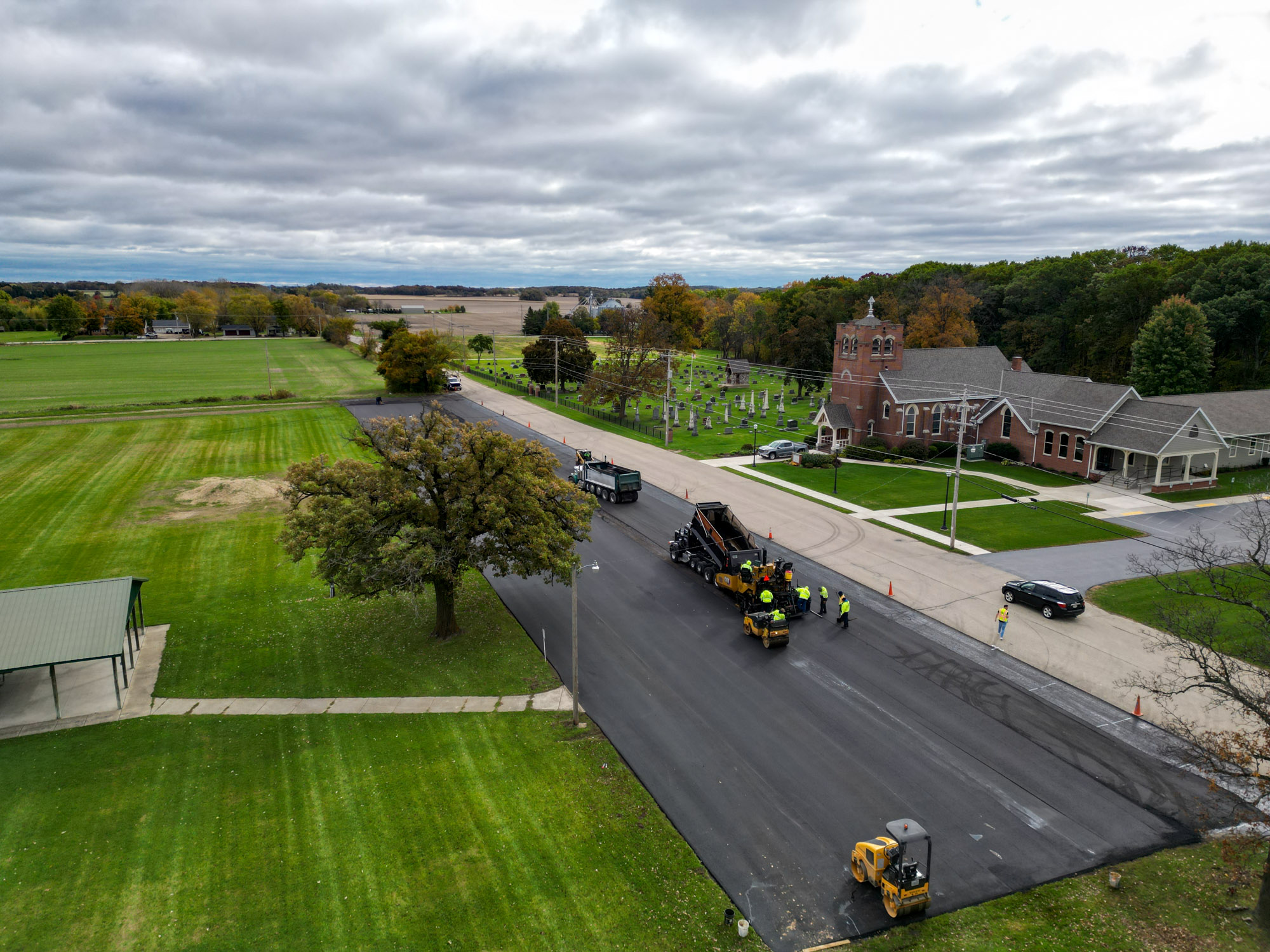
Parking Lot Paving in Waukesha, WI — Commercial Asphalt Services
A commercial parking lot in Waukesha takes a beating. Waukesha County averages more than 100 freeze-thaw cycles per year, and the heavy truck traffic feeding the industrial corridors along Sunset Drive and Moreland Boulevard compounds the stress on base layers that weren’t engineered for the load. When a parking lot fails, it doesn’t fail quietly: tenants complain, liability exposure grows, and a capital asset that should last 20-plus years starts draining your maintenance budget instead. Asphalt Contractors Inc. provides parking lot paving in Waukesha, WI at commercial scale, handling everything from full-depth new construction to mill-and-overlay resurfacing for property managers and facilities directors who need the job done right the first time.
Whether your property sits near the I-94/US-18 interchange, along one of Waukesha’s growing mixed-use corridors, or in an established office park, the scope and sequencing of your paving project matters as much as the mix design. This page covers every stage of the process so you can walk into a contractor conversation knowing exactly what to ask for.
Commercial Parking Lot Paving Services We Provide in Waukesha
Asphalt Contractors Inc. delivers the full spectrum of commercial paving work. Here’s what that looks like in practice for Waukesha-area properties:
- Full-depth new construction: Site clearing, subgrade preparation, aggregate base installation, and compacted asphalt layers built to handle your specific traffic class, from light passenger vehicles to heavy delivery trucks.
- Mill-and-overlay (asphalt resurfacing): When the existing base is structurally sound but the surface has deteriorated, milling removes 1.5 to 3 inches of worn pavement and a fresh asphalt layer bonds directly to the prepared surface. Significantly less disruptive than full replacement.
- Full-depth reclamation (FDR): For lots with severe base failure, FDR pulverizes the existing asphalt and blends it with the underlying aggregate, creating a stabilized base layer. This approach recycles material on-site and reduces haul costs substantially on large lots.
- Subgrade preparation and grading: Proper drainage starts at grade. We engineer cross-slopes and drainage flow before a single ton of asphalt goes down.
- ADA-compliant accessible stall layout: Every new or repaved lot must meet current ADA parking requirements, including accessible stall counts, van-accessible spaces, and compliant access aisles.
- Drainage slope engineering: Standing water is asphalt’s worst enemy in a freeze-thaw climate. We design surface slopes to move water off the lot quickly.
See examples of completed commercial projects in our asphalt paving projects portfolio.
New Construction vs. Full-Depth Reclamation: Choosing the Right Approach for Your Waukesha Property
This is the decision that drives the largest cost differences in a paving bid. Get it wrong and you either overspend on a new base that wasn’t necessary, or you invest in a surface overlay on a failing base that will crack again within three to five years.
The choice comes down to base condition. If your existing lot has widespread alligator cracking, significant rutting, or areas where the surface moves underfoot, the base has likely failed and a surface treatment won’t solve it. FDR or full removal and replacement is the right call. If the surface is worn and cracked but the base is still firm and draining correctly, mill-and-overlay adds 15 to 20 years of service life at roughly 40 to 60 percent of the cost of full replacement.
A proper condition assessment includes core samples to verify base depth and stability, not just a visual inspection from the parking lot surface. Knowing when to resurface versus when to sealcoat is a separate but related question for lots in earlier stages of wear. For lots near the end of their design life, our article on asphalt lifespan and replacement timing walks through the key indicators in detail.
Why Waukesha Commercial Properties Trust Asphalt Contractors Inc.
Large commercial paving projects move on tight schedules. A retail center can’t close its lot for two weeks during peak season. An industrial facility can’t block dock access during a production run. The contractor managing your project needs to understand phased construction, coordinate with your tenants or operations team, and hit milestones without supervision.
Asphalt Contractors Inc. has handled commercial-scale paving across southeastern Wisconsin for years, including projects along the I-94 corridor and throughout Waukesha County. Our crews work with property managers from initial site assessment through final striping. We know the WisDOT specifications relevant to commercial base construction in this region, and we hold the equipment and crew capacity to handle lots well above 100,000 square feet without subcontracting core work.
We’re also members of the National Asphalt Pavement Association, which means our mix designs and construction practices align with industry standards for durability and performance. You can review client feedback on our commercial work at our parking lot asphalt services review page.
Ready to discuss your Waukesha property? Contact our commercial paving team for a site assessment and project quote.
Industries and Property Types We Serve in the Waukesha Area
Commercial paving needs vary significantly by property type. A manufacturing facility with 80,000-pound trucks making daily deliveries needs a completely different base specification than a medical office park with standard passenger vehicles. We work across all of these property categories in and around Waukesha:
- Retail and shopping centers along Sunset Drive and the US-18 corridor, where high customer volume and snow removal equipment wear demand durable surface mixes
- Industrial and distribution facilities requiring heavy-duty base construction and reinforced turning radii at dock approaches
- Office parks and corporate campuses where curb appeal matters and phased paving lets the facility stay operational throughout the project
- Multi-tenant commercial properties where ADA compliance, stall counts, and drainage must be engineered to accommodate diverse tenant needs
- Municipal and institutional lots including government facilities, schools, and public parking areas in Waukesha County
Each project starts with a site visit and a scope conversation, not a generic per-square-foot estimate sent without seeing the property.
What to Expect During a Commercial Parking Lot Paving Project
A well-managed commercial paving project follows a predictable sequence. Here’s how Asphalt Contractors Inc. approaches it:
- Site assessment and core sampling: We evaluate base depth, soil bearing capacity, existing drainage patterns, and the extent of any subgrade failure before writing a scope of work.
- Project phasing plan: For occupied properties, we map out which sections of the lot can be closed and when, keeping adequate parking available for tenants throughout construction.
- Demolition and subgrade prep: Existing pavement is removed or milled; subgrade is graded, compacted, and corrected for drainage slope before any base aggregate goes down.
- Base and binder course installation: Aggregate base is compacted to specification, followed by the binder (base) asphalt course. Lift thicknesses are verified by the crew on-site.
- Surface course installation: The finish wearing course is placed and compacted to the correct density. Surface smoothness and cross-slope are checked before the crew leaves the site.
- Striping and ADA layout: After adequate cure time, line striping is applied per your site plan. Proper striping directly affects traffic flow, safety, and ADA compliance. See our resource on the importance of pavement striping for safety.
Total project duration for a mid-size commercial lot (30,000 to 60,000 square feet) typically runs three to seven business days depending on scope and weather. Larger lots with phasing plans take longer but keep the property functional throughout.
Waukesha’s Climate and Soil Conditions — How They Affect Your Asphalt
Waukesha County sits in a climate zone where pavement fails for different reasons than it does in warmer states. Understanding the local conditions explains why base engineering isn’t a place to cut costs.
Freeze-thaw cycling is the primary driver of premature failure. Water infiltrates surface cracks, freezes, expands, and widens those cracks with every cycle. Over three to five years on a poorly sealed or improperly drained lot, this process fractures the surface and destabilizes the base. Lots near Waukesha’s industrial corridors add heavy vehicle loading on top of climate stress, which accelerates the failure timeline considerably.
Waukesha County also has areas with clay-heavy subsoil, particularly away from the glacial gravel deposits found closer to the lake. Clay retains moisture, loses bearing capacity when saturated, and causes differential settlement. Proper subgrade stabilization, whether through aggregate replacement, geotextile fabric installation, or cement stabilization, is essential before paving over these soil conditions. A base that performs in Racine County may be undersized for a Waukesha site with poor-draining native soil.
The practical implication: base depth and drainage engineering for a Waukesha commercial lot should be designed by someone who knows the specific site, not copied from a standard spec sheet.
Keeping Your Investment Protected: Maintenance After Paving
A new commercial parking lot represents a significant capital investment, often $150,000 to $400,000 or more for a large property. A structured maintenance plan is what separates a 25-year asset from one that needs major work again in 10.
The most important early maintenance step is sealcoating, typically applied 12 months after initial paving and repeated on a 3 to 5 year cycle thereafter. Sealcoating slows UV oxidation, reduces water infiltration, and keeps the surface flexible through temperature swings. Crack routing and filling should happen as soon as cracks appear, before water gets into the base. These are lower-cost interventions that prevent much more expensive base repairs later.
Our articles on the benefits of maintaining your asphalt and how curb appeal affects your business cover the ROI case for proactive maintenance in more detail. Sealcoating and striping are separate services with their own project pages; this page focuses on the paving work that comes first.
Request a Commercial Parking Lot Paving Quote in Waukesha
Asphalt Contractors Inc. provides on-site assessments and written project quotes for commercial paving work throughout Waukesha and Waukesha County. We don’t quote from satellite images or per-square-foot rate cards. Every proposal is based on an actual site visit, core sample results where appropriate, and a scope of work matched to your property’s specific base conditions, traffic loading, and project timeline requirements.
To get started, contact our commercial paving team with your property address, a rough square footage estimate if you have it, and your target construction window. We’ll schedule a site visit and return a detailed written proposal. Most commercial quotes are delivered within five to seven business days of the site visit.
Request your commercial parking lot paving quote today.
Frequently Asked Questions
How long does a commercial parking lot paving project in Waukesha typically take?
For a mid-size commercial lot in the 30,000 to 60,000 square foot range, most projects run three to seven business days from demolition through final compaction. Larger properties, or projects requiring phased construction to keep part of the lot operational, take longer. Weather holds for rain or temperatures below 50°F can add days to the schedule. Your project manager will build a phasing timeline before work begins so you can notify tenants in advance.
What thickness of asphalt is recommended for a high-traffic commercial parking lot?
A standard commercial parking lot designed for passenger vehicles and light delivery trucks typically calls for 3 to 4 inches of compacted asphalt (binder plus surface course) over a properly prepared aggregate base of 6 to 10 inches. Properties with regular heavy truck access, such as loading docks or industrial facilities, require thicker sections, often 4 to 6 inches of asphalt over a deeper base. The right specification depends on your traffic loading data and subgrade conditions, which is why a site assessment precedes any recommendation.
Can you pave a parking lot in phases to keep part of it operational during construction?
Yes, and for occupied commercial properties it’s the standard approach. We divide the lot into sections, sequence the work to keep adequate stalls open at all times, and use temporary signage and barricades to direct traffic. Phase scheduling is coordinated with your operations or property management team before the first piece of equipment arrives on site.
How soon can vehicles use a newly paved commercial parking lot?
In normal Wisconsin summer conditions (temperatures above 70°F), newly paved asphalt is typically ready for vehicle traffic within 24 to 48 hours. Cooler temperatures slow the cooling and curing process, and very heavy vehicles like loaded semi-trucks should stay off new asphalt for 72 hours or more. Your project manager will give you a specific re-opening window based on the mix placed and the forecast at the time of paving.
Does Waukesha’s freeze-thaw cycle require any special base preparation?
It does. Waukesha County’s 100-plus annual freeze-thaw cycles put repeated stress on base layers, especially where subgrade soils retain moisture. Standard practice for new commercial construction in this region includes proper subgrade compaction, aggregate base depths sized for frost load, and careful attention to drainage slope so water drains off the surface and away from the base quickly. In areas with clay-heavy native soil, subgrade stabilization may be required before base aggregate is placed. Skipping or minimizing these steps is the most common reason a parking lot fails well before its design life.
What ADA compliance requirements apply to a newly paved commercial parking lot in Wisconsin?
Under the Americans with Disabilities Act, commercial parking facilities must provide a minimum number of accessible spaces based on total lot size, with at least one van-accessible space per facility. Access aisles must be a minimum of 60 inches wide (96 inches for van-accessible spaces), and the accessible route from the parking stall to the building entrance must meet slope and surface requirements. Wisconsin follows federal ADA standards for parking; the ADA’s parking guidance outlines the specific stall counts and dimensional requirements. Any new paving or resurfacing project is an opportunity to bring the lot into current compliance, and Asphalt Contractors Inc. incorporates ADA-compliant layouts into every commercial paving plan.
A commercial parking lot in Waukesha is a long-term asset. Built correctly with proper base depth, drainage engineering, and the right asphalt specification for Wisconsin’s climate, it performs reliably for 20 to 25 years with routine maintenance. Built to a low-bid spec without a site assessment, it becomes a recurring capital expense within a decade. Asphalt Contractors Inc. has the equipment, crew capacity, and local knowledge to do the job correctly for properties of any size in Waukesha and throughout Waukesha County.
Contact Asphalt Contractors Inc. today to schedule a site assessment and receive a written commercial paving proposal. Get your Waukesha parking lot paving quote here.