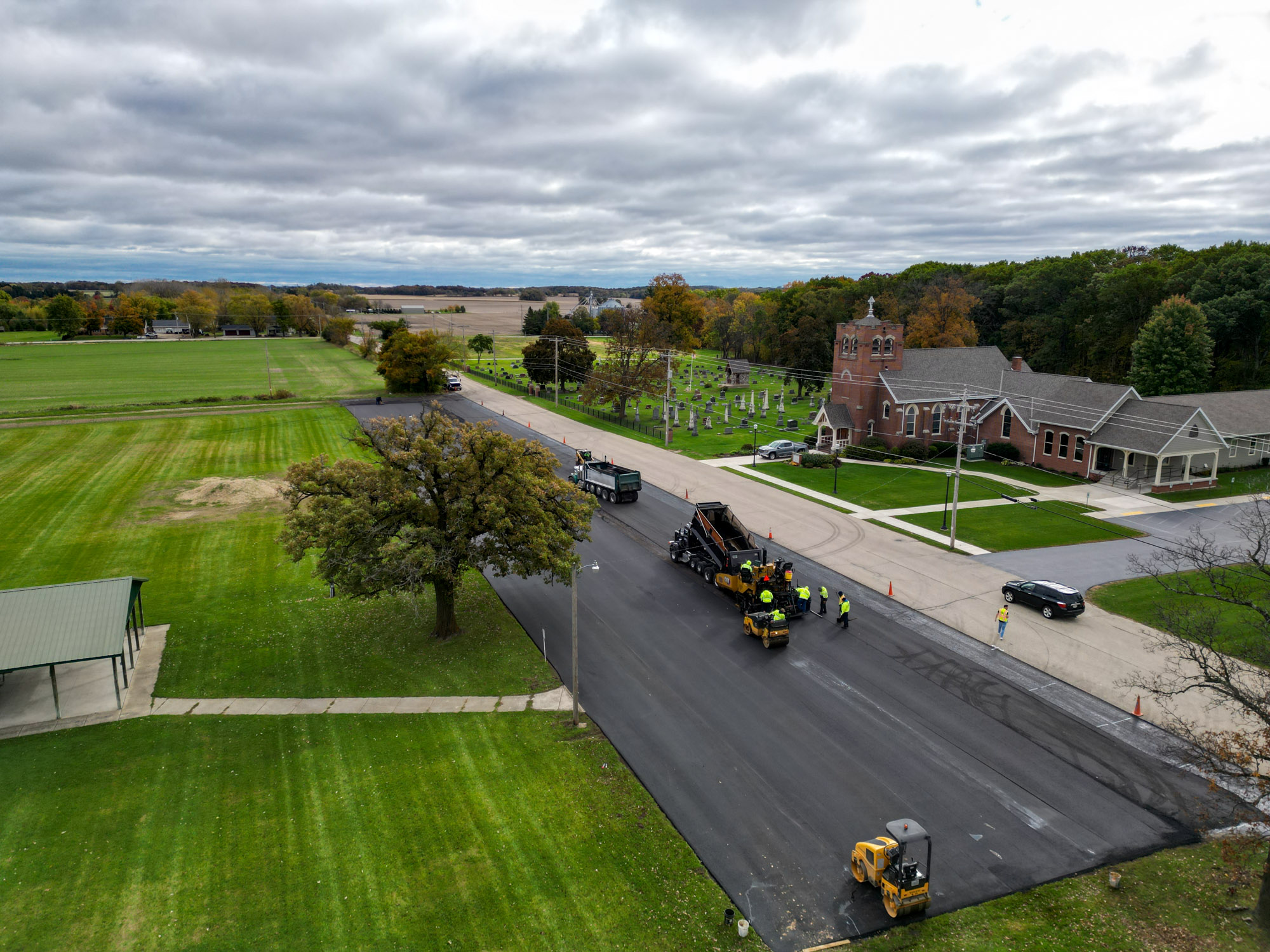
Commercial Asphalt Paving in Waukesha, WI
Waukesha County’s commercial corridors along I-94, Highway 18, and Pewaukee Road carry serious traffic volume, and the pavement holding up under that load is a liability issue as much as a maintenance issue. Asphalt Contractors Inc. delivers commercial asphalt paving in Waukesha, WI at the scale and specification level that property managers and facility owners actually need: new lot construction, full-depth reclamation, access road work, and everything in between. Our crews and equipment are sized for multi-acre sites, not weekend projects.
From the industrial parks near the Waukesha County Business Alliance corridor to the medical campuses near downtown and the retail centers along Silvernail Road, we work across the full range of commercial property types in this market. If you’re managing paved surfaces that represent a six- or seven-figure replacement value, you need a contractor who treats the job that way.
Full-Scale Commercial Asphalt Paving Services in Waukesha
Our commercial paving services cover the full project lifecycle, from raw site preparation through final striping. Here’s what that looks like in practice for Waukesha-area commercial clients:
- New construction paving: Full subbase installation, grading, and asphalt placement for new parking lots, access roads, and facility yards
- Full-depth reclamation (FDR): Grinding and reprocessing the existing pavement and base as a stabilized foundation before repaving, ideal for heavily deteriorated lots
- Mill-and-overlay resurfacing: Removing the top 1.5 to 2 inches of failed asphalt and installing a fresh surface course
- Parking lot expansion: Tying new paving into existing grades and drainage patterns across larger footprints
- Commercial access road construction: Private roads within industrial campuses, logistics yards, and multi-building office parks
- Site grading and base preparation: Establishing proper drainage slopes and compacted aggregate base before any asphalt goes down
- ADA-compliant layout work: Accessible stall sizing, ramp placement, and slope compliance as part of the paving scope
- Pavement striping and marking: Traffic flow lanes, stall markings, fire lanes, and ADA symbols applied after paving
Every project starts with a site assessment, not a generic quote. Conditions vary significantly across Waukesha County’s commercial properties, and the right solution depends on what’s actually there.
Who We Serve: Commercial Properties & Industries in Waukesha County
Waukesha County has one of the most economically diverse commercial real estate profiles in southeastern Wisconsin. The clients we work with reflect that range:
- Industrial and manufacturing facilities: Heavy truck traffic and forklift loads demand pavement built to a different specification than a standard parking lot. We design accordingly.
- Medical and healthcare campuses: Patient and visitor traffic, emergency vehicle lanes, and accessible parking compliance are all factors near Waukesha’s downtown medical district.
- Retail strip centers and big-box anchored sites: High daily traffic counts, seasonal plowing loads, and curb appeal all factor into how we spec and sequence a retail paving project.
- Multi-tenant office parks: Coordinating paving work around tenant schedules and lease obligations requires real project management, not just equipment.
- Municipal and institutional facilities: Government buildings, school district facilities, and public infrastructure projects where documentation and compliance matter as much as the paving itself.
- Logistics and distribution centers: Loading dock aprons, truck courts, and staging yards that take sustained heavy loads require a purpose-built base section.
Our commercial asphalt services across the Milwaukee metro extend into Waukesha County with the same crew depth and equipment capacity we bring to larger regional projects.
The Commercial Paving Process: What Waukesha Property Owners Can Expect
A well-run commercial paving project follows a defined sequence. Skipping steps creates problems that show up within two or three Wisconsin winters. Here’s how we approach it:
- Site assessment and scope definition: We evaluate existing pavement condition, drainage patterns, subbase depth, and load requirements before writing a proposal. This is where the scope gets defined, not assumed.
- Base preparation: For new construction or full reclamation projects, this means excavating to the required depth, installing properly graded aggregate base, and compacting to spec. This is the most critical phase.
- Fine grading: Establishing precise slopes to direct water away from structures and toward designed drainage points. Poor grading is the leading cause of premature pavement failure in Wisconsin.
- Asphalt installation: Hot-mix asphalt placed in one or more lifts depending on design depth, using commercial-grade paving equipment calibrated for large continuous runs.
- Compaction: Steel drum and pneumatic rollers achieve the density spec required for the traffic loading the lot will see. Under-compaction shortens pavement life significantly.
- Striping and marking: Painted once the surface has cured, covering all traffic lanes, stalls, fire lanes, and ADA markings per current code.
- Final inspection and documentation: We walk the site with the property contact before closing out the project.
Want to understand more about how pavement condition affects the right treatment choice? See our guide on when to resurface versus seal coat.
Why Waukesha’s Climate Demands High-Performance Asphalt
Southeastern Wisconsin averages more than 30 freeze-thaw cycles per year. Each cycle stresses pavement by forcing water that has infiltrated surface cracks to expand as it freezes, then contract again when it thaws. Over time, that movement breaks down both the asphalt surface and the subbase beneath it. For a commercial lot handling daily traffic from delivery trucks, employee vehicles, and customers, that deterioration accelerates fast.
Properly specified commercial asphalt for this climate requires several things working together:
- Adequate base depth: A commercial lot in Wisconsin typically needs 6 to 12 inches of compacted aggregate base depending on soil conditions and load class. Cutting this short is a false economy.
- Correct asphalt mix design: Mix selection affects flexibility, rut resistance, and how the pavement performs across the temperature range Wisconsin sees from July to January.
- Drainage design that works: Standing water accelerates freeze-thaw damage. Every commercial paving project we do incorporates deliberate slope design to move water off the surface quickly.
- Compliance with applicable standards: Projects involving public-adjacent infrastructure are designed in reference to Wisconsin Department of Transportation standards for pavement thickness and material specification.
For a deeper look at what affects pavement longevity in this climate, our resource on asphalt lifespan factors covers the variables in detail.
Parking Lot Construction, Resurfacing & Reconfiguration for Commercial Sites
The right approach for a commercial parking lot depends on what’s actually wrong with it. Not every deteriorated lot needs to be torn out and rebuilt. Not every worn lot can be fixed with an overlay. The decision framework matters:
New construction is the right call when you’re developing a site from scratch, expanding a lot into previously unpaved area, or when existing base conditions are so compromised that resurfacing would just be putting new asphalt on top of a structural failure.
Mill-and-overlay works when the subbase is structurally sound and the surface course has worn or cracked beyond seal-coat correction. Milling removes the failed surface layer and gives the new overlay a proper bond. Most commercial lots in decent shape qualify for this treatment and it’s typically less than half the cost of full reconstruction.
Full-depth reclamation is the answer when the pavement has failed structurally but the material itself can be reprocessed. The existing asphalt and base are ground together, stabilized, recompacted, and used as the new base for a fresh surface. It’s a cost-effective alternative to full demolition and haul-off on the right sites.
If you’re unsure where your lot falls, a condition assessment will tell you. A $15,000 overlay decision made on a lot that actually needs reclamation will cost more in the long run than doing it right the first time. Good maintenance decisions also protect the investment after paving; see our notes on the benefits of maintaining commercial asphalt.
Road Construction and Large-Scale Site Work in the Waukesha Area
Not every commercial paving need fits the parking lot model. Industrial campuses, business parks, and institutional facilities often include private road networks, truck access corridors, and paved yard areas that are road-grade projects, not lot projects.
We have the equipment and crew capacity for that scale of work. That includes:
- Private road construction within industrial parks and multi-building commercial campuses
- Heavy-duty truck court and loading dock apron construction built to handle Class 8 vehicle loads
- Paved utility and maintenance access roads across large facility footprints
- Intersection improvements and turn lane additions on private commercial property
- Site work coordination with civil engineers, general contractors, and municipal permitting requirements
Large-scale site work requires a contractor who can manage sequencing, coordinate with other trades, and maintain production across a multi-week schedule without shutting down an operating facility. That’s a project management problem as much as a paving problem. The National Asphalt Pavement Association publishes quality guidelines and best practices that inform how we approach road-grade commercial projects.
Why Waukesha Businesses Choose Asphalt Contractors Inc.
Asphalt Contractors Inc. has been doing commercial paving work across southeastern Wisconsin for decades. Our footprint covers Milwaukee, Waukesha, Racine, Kenosha, and the surrounding counties, which means we know this market’s soil conditions, drainage patterns, and weather realities from direct experience, not guesswork.
A few things that matter to commercial property managers evaluating paving contractors:
- Equipment capacity: We run commercial-grade pavers, milling machines, and compaction equipment. We’re not scaling up light equipment to handle a heavy job.
- Project management: A dedicated point of contact manages scheduling, phasing, and communication from site assessment through final walkthrough. You won’t be tracking down a crew lead for status updates.
- Regional familiarity: We’ve worked on the kind of properties common to Waukesha County, from industrial facilities near the I-94 corridor to medical campus lots near downtown, and that experience shapes how we spec and execute each project.
- Documented work: Our commercial paving project portfolio shows the scale and variety of work we handle across the region.
Well-maintained commercial pavement also directly affects how your property presents to tenants, customers, and visitors. Our piece on curb appeal and its impact on commercial properties covers that angle in more detail.
Frequently Asked Questions About Commercial Asphalt Paving in Waukesha
Below are answers to the questions commercial property owners and managers most commonly ask when evaluating a paving project in Waukesha County.
Frequently Asked Questions
How long does a commercial asphalt parking lot last in Wisconsin’s freeze-thaw climate?
A properly constructed commercial lot in southeastern Wisconsin typically lasts 20 to 30 years before it needs full reconstruction. Surface resurfacing or mill-and-overlay work is often needed at the 12 to 15-year mark depending on traffic loading and how well drainage was designed into the original build. Lots with inadequate base depth or poor drainage can fail significantly sooner. Regular condition assessments help you plan capital expenditures before a lot reaches crisis condition.
What is the typical timeline for a large commercial paving project in Waukesha?
Most commercial parking lot projects in the 1 to 5-acre range take 2 to 5 days of active paving once mobilization begins. Larger projects, road construction work, or jobs requiring phased closures to keep a facility operating take longer and are scheduled with the property contact in advance. Lead time for scheduling depends on the season; spring and early summer slots fill quickly. Getting on the schedule early in the calendar year is the best way to secure your preferred window.
When is the best time of year to schedule commercial asphalt paving in southeastern Wisconsin?
The optimal paving season in Wisconsin runs from late April through October, when ground and air temperatures consistently support proper asphalt compaction and curing. Mid-summer is the most productive window. Fall paving is feasible but requires tighter scheduling because cold snaps can arrive quickly. Spring paving should wait until the ground has fully thawed and stabilized, usually by late April or early May. Avoid scheduling asphalt work during periods of sustained cold or rain, which affect mix placement and compaction quality.
Do you handle ADA-compliant parking lot layouts and striping as part of the paving project?
Yes. ADA compliance work, including accessible stall count, stall dimensions, van-accessible spaces, access aisle widths, and ramp slope requirements, is incorporated into the project scope from the layout phase. Striping is applied after the asphalt surface has cured and includes all required ADA symbols and markings. If you’re reconfiguring an existing lot, we review current compliance gaps as part of the site assessment so the finished project meets current requirements.
What is the difference between full-depth reclamation and resurfacing for a commercial lot?
Resurfacing (mill-and-overlay) removes only the top layer of failed asphalt and replaces it with a new surface course. It works when the underlying base structure is still sound. Full-depth reclamation grinds the entire existing pavement and a portion of the base together, then reprocesses and recompacts that material as a new stabilized base before a fresh asphalt surface is placed on top. Reclamation is the right choice when the pavement has failed structurally, not just at the surface. It typically costs less than full demolition and reconstruction while achieving a comparable result.
Commercial pavement is a long-term asset. A 20,000-square-foot parking lot represents a significant capital investment, and how it’s built determines whether it lasts 10 years or 25. For property owners and managers in Waukesha County, getting the specification and execution right from the start is the most cost-effective decision you can make.
Asphalt Contractors Inc. is ready to assess your site and provide a detailed commercial paving proposal. Request a commercial paving quote or call us directly to schedule a site assessment for your Waukesha-area property.