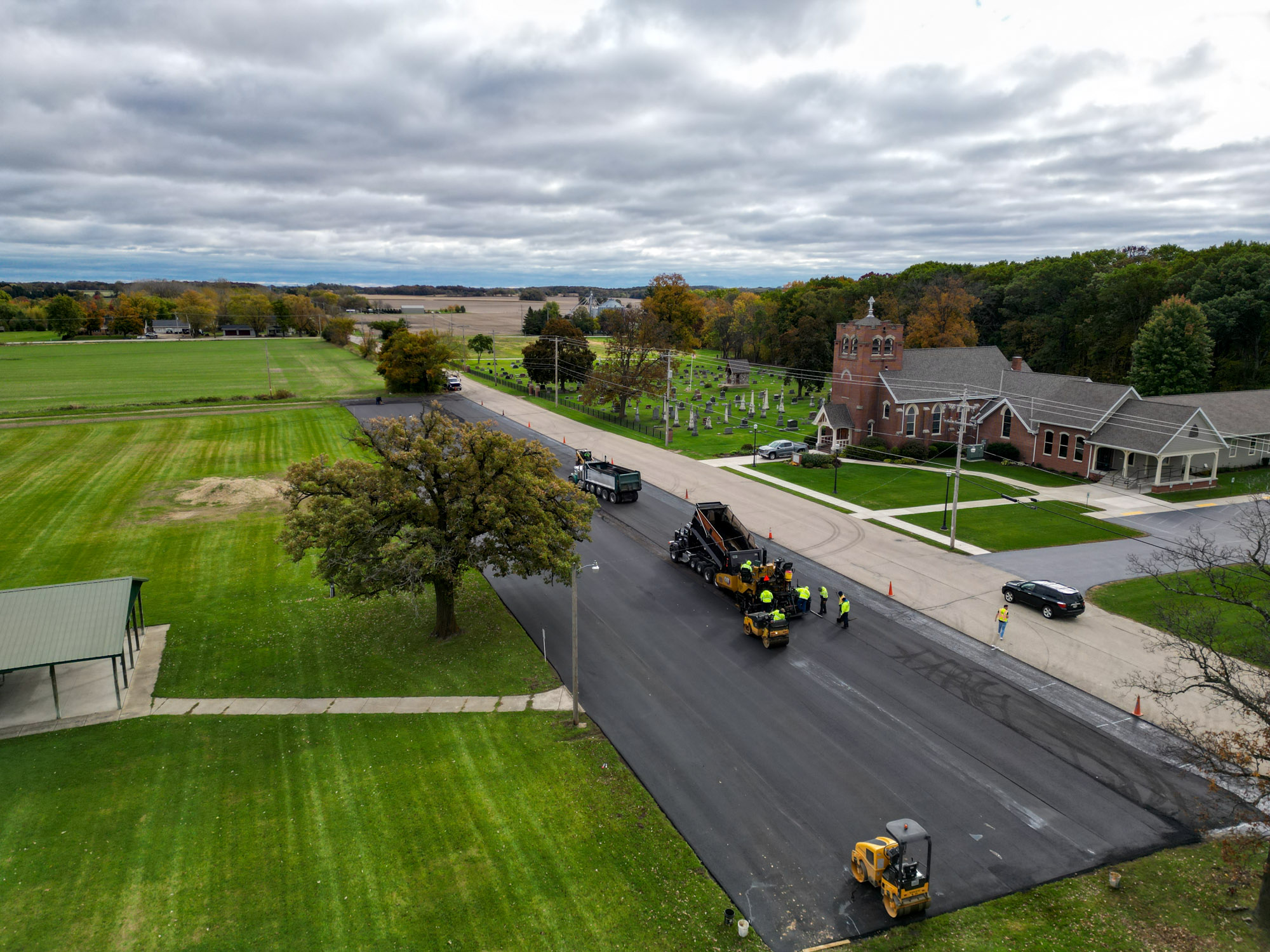
What Permits Are Needed for Commercial Asphalt Paving in Wisconsin?
If you manage commercial property or oversee large-scale site development in southeastern Wisconsin, understanding what permits are needed for commercial asphalt paving in Wisconsin can save you weeks of delay and significant rework costs. Requirements vary by project size, proximity to state highways, and the municipality where the work takes place, whether that’s Milwaukee, Waukesha County, Kenosha, or Racine. This page answers the questions we hear most from property managers and general contractors before a project breaks ground.
Who Is This Guide For?
This guide is written for commercial property owners, property managers, and general contractors planning large-scale paving projects in Wisconsin. That includes new parking lot construction, road-adjacent access improvements, full-depth reclamation, and any site work that involves grading or stormwater changes. If you’re coordinating a project at a retail center, industrial campus, municipal facility, or mixed-use development in the Milwaukee metro area, these answers apply directly to your situation.
Permit requirements at the commercial scale involve at least three separate tracks: state environmental review, local municipal approvals, and potentially WisDOT access permits. Skipping any one of them can stop a project mid-construction. The FAQ below walks through each track in plain terms.
Wisconsin Commercial Asphalt Paving Permit Questions Answered
The questions below are grouped by topic: permit basics and thresholds first, then state and environmental requirements, then local and municipal approvals, and finally process and responsibility questions. Each answer reflects publicly documented Wisconsin requirements as of the time this page was written. For project-specific guidance, consult your contractor and the relevant permitting authority before mobilizing equipment.
Frequently Asked Questions
Do I need a permit for commercial asphalt paving on private property in Wisconsin?
Usually yes, even on private property. Most Wisconsin municipalities require a building permit, grading permit, or land disturbance permit for commercial paving projects above a certain area threshold. The specific trigger varies by city and county. In Milwaukee, Waukesha, Kenosha, and Racine, thresholds and application requirements differ, so you need to contact your local building or engineering department before work starts. The fact that the land is privately owned does not exempt the project from local code or state environmental rules.
What is a land disturbance or grading permit and when does it apply to a paving project?
A land disturbance or grading permit authorizes earthwork: cutting, filling, grading, or any activity that changes the existing grade of a site. For commercial paving projects, this permit typically applies whenever a contractor moves soil, installs a base course on previously undeveloped ground, or expands an impervious surface area. Municipalities issue these permits through their engineering or public works departments. Approval often requires a grading plan stamped by a licensed engineer, an erosion control plan, and sometimes a stormwater management plan showing how runoff will be handled after paving is complete.
When does a commercial paving project require a Wisconsin DNR stormwater permit?
The Wisconsin DNR requires a Construction Site Stormwater Permit (filed as a Notice of Intent under NR 216) for any land-disturbing activity that covers one acre or more. Projects smaller than one acre also need this permit if they are part of a larger common plan of development that collectively disturbs one acre or more. For a typical commercial parking lot expansion or new lot construction at an industrial or retail site, the one-acre threshold is easy to reach. The permit requires an approved Stormwater Pollution Prevention Plan (SWPPP) before grading begins. See the Wisconsin DNR construction stormwater page for current Notice of Intent forms and guidance.
Does paving near a Wisconsin highway or right-of-way require a WisDOT access permit?
Yes. Any new or modified driveway or access point connecting to a state highway requires a highway access permit from the Wisconsin Department of Transportation. This applies to commercial properties along state trunk highways throughout the Milwaukee metro and southeastern Wisconsin. The permit review covers sight-distance standards, turning movement analysis, and the impact on highway traffic flow. Projects that involve significant access changes, such as adding a new entrance for a distribution center or reconfiguring a retail parking lot entrance off a state route, should budget several weeks for WisDOT review. Details are on the WisDOT engineering permits page. For road-scale projects, see our work as a road reconstruction contractor in southeast Wisconsin.
What local municipal permits are typically required for commercial parking lot construction?
At the municipal level, commercial paving projects commonly require one or more of the following: a building permit (which may cover site improvements), a grading or land disturbance permit, a right-of-way permit if work touches a public street or sidewalk, and an erosion control permit. Some municipalities also require a pre-construction meeting with their engineering department. Milwaukee, Waukesha County, Kenosha, and Racine each maintain their own fee schedules and submittal checklists. There is no single statewide form. Contact the building or engineering department for the municipality where the project site is located before submitting any design drawings. Our team handles parking lot construction in Milwaukee and can advise on local submittal requirements based on current project experience.
Are there zoning or site plan approvals needed before paving a commercial lot in Wisconsin?
Frequently yes. Many Wisconsin municipalities require a site plan review before any significant change to impervious surface on a commercial property. Zoning boards evaluate landscaping, setbacks, drainage, and parking count compliance before approving new paving. Projects that subdivide land or create new parcels may also be subject to Wisconsin Statute 236, which governs land subdivision and plat approval. If your project is part of a broader site redevelopment, start the zoning review early. Approvals at this stage can take longer than the construction permits themselves, and a delayed zoning decision will push your entire project schedule. Review our commercial paving timeline guide to see how permit phases fit into the overall schedule.
Who is responsible for pulling permits on a commercial asphalt paving project: the owner or the contractor?
Responsibility depends on the permit type and the contract structure. Grading and land disturbance permits are typically pulled by the contractor or a licensed engineer working on behalf of the owner. WisDOT access permits are usually the owner’s responsibility, though a contractor or engineer can manage the application process. Municipal building permits can be pulled by either party. The safest approach: clarify permit responsibility in the contract before work begins, and confirm that whoever pulls the permit holds the appropriate license or certification required by the issuing authority. On complex commercial projects, a general contractor often coordinates all permits as part of the project scope.
How long does it take to get permits approved for a large commercial paving project in Wisconsin?
Timelines vary significantly by permit type and municipality. A straightforward municipal grading permit in a smaller community might take two to three weeks. A DNR Notice of Intent under NR 216 can take four to six weeks or longer if the SWPPP requires revision. A WisDOT access permit for a complex highway connection can run eight to twelve weeks. In the Milwaukee metro area, municipal queues can extend timelines further during peak construction season. Plan permit applications well ahead of your target construction start. Permitting delays are one of the most common reasons commercial paving projects miss their target completion dates. For help thinking through project costs alongside scheduling, see our guides on budgeting for a commercial parking lot paving project and what commercial asphalt paving costs.
What happens if commercial paving work begins without the required permits in Wisconsin?
Starting work without permits exposes the property owner and contractor to stop-work orders, fines, and mandatory remediation. Municipal inspectors can halt a project on the spot and require restoration of the disturbed area before a permit will be issued. Wisconsin DNR violations for unpermitted stormwater disturbance carry separate penalties. In some cases, finished pavement has been required to be removed to allow inspection of underlying drainage infrastructure. The cost and schedule impact of a stop-work order on a commercial site typically far exceeds the cost of obtaining permits up front.
Does repaving or resurfacing an existing commercial lot require the same permits as new construction?
Not always, but don’t assume an overlay is permit-free. If the resurfacing project stays within the existing footprint and does not change drainage patterns or disturb more than the threshold acreage, many municipalities will not require a full grading permit. However, if the project expands the paved area, changes grades, adds new curb or drainage structures, or triggers the DNR’s one-acre land disturbance threshold, permits apply just as they would for new construction. Always confirm with the local municipality and review the scope against DNR NR 216 thresholds before assuming a mill-and-overlay or full-depth resurfacing project is exempt.
Permit requirements for commercial asphalt paving in Wisconsin touch multiple agencies, and the specific combination depends on your project’s size, location, and proximity to state infrastructure. Getting the permit track right before mobilization protects your schedule and your budget. Asphalt Contractors Inc. works with property managers and general contractors throughout southeastern Wisconsin on projects ranging from large parking lot construction to road-scale work. Contact us before your project goes to bid and we can walk through what permits will likely apply based on your site conditions.