Why ADA Compliance Matters in 2026 for Wisconsin Parking Lots
ADA compliant parking lot striping protects your customers, your reputation, and your bottom line. Clear, accurate striping makes it easier for people with disabilities to reach your entrance safely and confidently. It also reduces risk by helping your business meet federal requirements and common local expectations in Wisconsin. Fines for violations can be costly, and lawsuits can be even more expensive. Good striping also boosts curb appeal and traffic flow. If you operate a retail center, office, industrial site, medical building, multifamily property, or hospitality venue in Southeast Wisconsin, a careful 2026 refresh of your layout can pay back quickly.
Asphalt Contractors Inc. has helped businesses across Racine, Kenosha, Walworth, Waukesha, and Milwaukee counties meet ADA requirements and local standards since 1979. Because we manufacture our own asphalt and use proven marking materials, we keep quality high and life cycle costs low. The 2026 season is the perfect time to verify that your parking lot striping and signage align with ADA guidelines and Wisconsin best practices.
Your 2026 ADA Parking Lot Striping Checklist
The ADA Standards for Accessible Design provide the baseline used throughout Wisconsin. Local authorities may add details for signage, colors, or penalties. Use this checklist to evaluate your lot, then have Asphalt Contractors confirm dimensions, slopes, and materials before painting.
1. Verify the Required Number of Accessible Spaces
Count all parking spaces that serve the same facility, including employee and visitor spaces, to set the correct number of accessible stalls. Use the following ADA counts:
- 1 to 25 total spaces: 1 accessible space
- 26 to 50: 2 accessible spaces
- 51 to 75: 3 accessible spaces
- 76 to 100: 4 accessible spaces
- 101 to 150: 5 accessible spaces
- 151 to 200: 6 accessible spaces
- 201 to 300: 7 accessible spaces
- 301 to 400: 8 accessible spaces
- 401 to 500: 9 accessible spaces
- 501 to 1000: 2 percent of total spaces
- 1001 and over: 20 plus 1 for each 100 over 1000
At least one in every six accessible spaces, or at least one total, must be van accessible. Medical facilities have higher requirements. Outpatient facilities typically need 10 percent accessible. Facilities that specialize in physical therapy or rehabilitation may require 20 percent. Asphalt Contractors can confirm counts for special occupancies during a site assessment.
2. Place Accessible Spaces on the Shortest Accessible Route
Accessible stalls and their access aisles must connect to an accessible route that leads to the accessible entrance. The route must avoid stairs and steep slopes. If your building has multiple accessible entrances, place accessible stalls near each entrance they serve. In multi-tenant sites, distribute accessible spaces among major entrances when practical. Avoid routing pedestrians behind busy drive lanes or through loading areas.
3. Confirm Stall and Aisle Dimensions
Use these standard ADA dimensions for parking lot striping. Asphalt Contractors verifies field conditions and uses the best layout for your site:
- Standard accessible car space: 8 feet wide minimum, with a 5 foot wide access aisle
- Van accessible options:
- Option A: 8 foot wide space with an 8 foot wide access aisle
- Option B: 11 foot wide space with a 5 foot wide access aisle
- Access aisle location: directly adjacent to the space, full length of the stall
- Shared aisles: one access aisle may serve two adjacent accessible spaces
Keep the surface slope of both the space and the aisle under 1:48 in all directions. That is roughly 2 percent. Steeper slopes can cause wheelchairs to roll and create difficulty for lifts. If your lot has settled, Asphalt Contractors can mill, pave, or patch to restore compliant slopes before restriping.
4. Lay Out and Mark Access Aisles
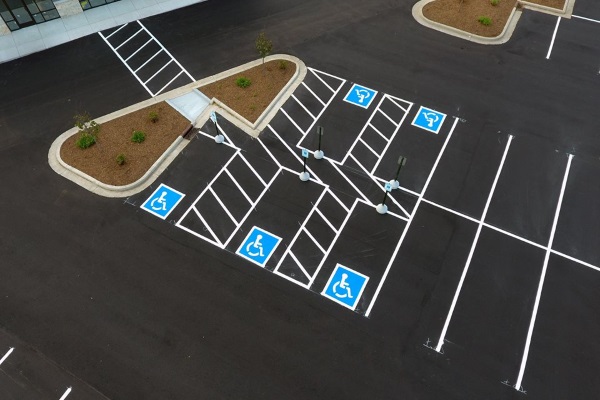
Access aisles must be clearly marked so drivers do not park in them. The aisle must connect to the accessible route without a curb or step. Avoid placing curb ramps inside the access aisle. Place curb ramps at the sidewalk or at the head of the space so they do not block loading or unloading from side doors. Mark the aisle with high contrast striping and include No Parking text where allowed. In Wisconsin, blue hatching for the access aisle is common, and white stall lines provide good contrast. Always confirm color requirements with your local authority.
5. Set Signage to Wisconsin Expectations
Every accessible stall must have a posted sign with the International Symbol of Accessibility mounted high enough to be visible even when a vehicle is parked. ADA requires at least 60 inches to the bottom of the sign. With Wisconsin winters and snow piles, 7 feet to the bottom of the sign is a practical target in many lots. Van accessible spaces need an extra sign that reads Van Accessible. Some Wisconsin jurisdictions also post a penalty sign. Asphalt Contractors can supply and install posts, breakaway bases, and compliant signs at the correct height. We also verify sign placement so plows and delivery trucks do not damage them.
6. Keep Routes Smooth, Clear, and Visible
After parking, users must be able to reach your entrance on a continuous, stable, and slip resistant route. Check for potholes, spalled concrete, lifted slabs, broken curbs, or drainage issues. Sidewalk cross slope should be under 1:48. Running slope can be up to 1:20. If steeper, it becomes a ramp and must meet ramp handrail and landing rules. Where local standards require detectable warnings at vehicular transitions, add truncated dome panels at curb ramps. Asphalt Contractors repairs pavement and concrete and installs panels when needed so your striping and routes work together.
7. Choose Durable Striping Materials for Wisconsin Weather
Harsh freeze-thaw cycles and deicing salts can shorten the life of pavement markings. For 2026, consider premium materials that last longer between maintenance cycles:
- High solids or low temperature acrylic traffic paint for early spring projects
- Two-part epoxy or methyl methacrylate for high traffic areas
- Thermoplastic or preformed thermoplastic at drive lanes and symbols
- Glass beads for night visibility where appropriate
- 4 inch to 6 inch line widths for stall lines, wider for crosswalks and stop bars
Asphalt Contractors selects materials to match your lot’s traffic, budget, and sweeping or plowing practices. We also schedule work around your peak hours to keep your business moving.
8. Plan Efficient Layouts That Fit Your Site
Good parking lot striping balances capacity, safety, and clear navigation. Use these layout tips for common Wisconsin properties:
- Small retail or office lots: 90 degree stalls maximize count. Keep accessible stalls by the primary entrance and avoid backing conflicts by adding a painted pedestrian path.
- Mid-size centers: 60 degree angled stalls improve flow. Place accessible spaces on the flattest section near major storefronts. Add stop bars and crosswalks at internal drives.
- Large campuses: Distribute accessible parking near key buildings. Provide loading zones and passenger drop-off with clear signage. Use islands to protect signs and reduce plow damage.
Example counts and concepts:
- 48-space retail: 2 accessible spaces total, 1 van accessible. One shared 8 foot aisle can serve two 8 foot spaces.
- 180-space hotel: 6 accessible spaces, at least 2 van accessible. Split near main entrance and conference entry.
- 1200-space event venue: 20 plus 1 for each 100 over 1000 equals 23 accessible spaces, with at least 4 van accessible. Group near main gates and secondary gates, each on a near-level surface.
9. Add Required Symbols and Text
Paint the International Symbol of Accessibility in each accessible stall or as required by your local authority. Many Wisconsin owners add the symbol in the space and stripe the access aisle with diagonal lines. Include Nosy drivers often stop in an aisle if it is not obviously restricted, so No Parking text in the access aisle is a smart addition when permitted. Use contrasting colors for visibility. Asphalt Contractors sizes symbols to match your stall widths and applies them with templates for clean edges.
10. Confirm Fire Lanes and Loading Zones
While not part of ADA, fire lanes and loading zones affect your accessible routes and wayfinding. Coordinate red or yellow curb markings, fire lane text, and loading zone signs so they do not interfere with accessible paths. Keep hydrants and standpipes clear. Our team lays out the whole site plan so nothing conflicts.
11. Document and Maintain
Keep a simple record of your 2026 striping plan and measurements. Inspect annually after winter. Refresh paint when lines fade below 50 percent visibility. Reseal or repave as needed to preserve slopes and smoothness. A typical Wisconsin repaint cycle is 12 to 36 months depending on traffic, snow removal, and material type. Asphalt Contractors offers maintenance plans so your lot stays compliant year after year.
Common ADA Striping Mistakes in Wisconsin and How to Fix Them
- Incorrect counts: Owners sometimes base counts on customer spaces only. Fix by recounting all spaces that serve the facility and updating markings.
- Wrong slopes at stalls: Even a good layout fails if the surface is too steep. Fix by patching or milling the affected area and restriping.
- Aisles too narrow: A 4 foot aisle is not enough. Fix by restriping to the correct width or converting two stalls to one stall plus a wider aisle.
- Curb ramp in the access aisle: Ramps reduce the level loading area. Fix by moving the ramp to the sidewalk or stall head and restoring a full flat aisle.
- Missing van accessible signs: The space might be wide enough but lacks the sign. Fix by adding the Van Accessible sign at the correct height.
- Faded hatching: Without high contrast stripes, drivers park in aisles. Fix by cleaning and repainting with bright, durable paint and adding No Parking text.
- Plow damage to posts: Shallow or unprotected posts bend or snap. Fix by installing posts on islands with breakaway bases and proper depth.
2026 Parking Lot Striping Specs at a Glance
- Counts: Use ADA table and remember at least one van accessible
- Location: Shortest accessible route to the entrance on the most level area
- Space width: 8 feet for cars, 8 or 11 to 12 feet for vans depending on aisle width
- Access aisle: 5 feet minimum for cars, 5 or 8 feet for vans, full length of stall
- Slopes: Under 1:48 for spaces and aisles
- Signs: International Symbol of Accessibility, plus Van Accessible for van stalls, 60 inches minimum to the bottom of the sign, taller preferred in snow zones
- Markings: High contrast lines, clear hatching, and optional No Parking in aisles per local rules
- Routes: Smooth, stable surface with correct cross and running slopes, curb ramps out of aisles
How Asphalt Contractors Simplifies ADA Compliance
Asphalt Contractors Inc. is a full-service paving contractor based in Union Grove, Wisconsin. Since 1979, we have delivered asphalt and concrete solutions from design to striping. Because we manufacture our own asphalt and control the process end to end, we meet tight schedules and keep quality consistent. Here is how we help you prepare for the 2026 season:
- On-site ADA assessment: We measure stall widths, slopes, routes, and sign heights, then provide a simple plan with counts and details.
- Layout and design: Our team designs efficient parking lot striping that meets ADA and matches Wisconsin expectations for signage and colors.
- Pavement repairs: Milling, patching, paving, and concrete work to create smooth, compliant surfaces.
- Professional striping: High visibility lines, symbols, and stencils applied with top-grade materials that stand up to Wisconsin weather.
- Signage supply and install: Code-ready posts and signs set to the correct height with durable hardware.
- Maintenance plans: Scheduled inspections and restriping to keep your lot compliant and looking sharp.
Whether you manage one small lot or a multi-site portfolio across Southeast Wisconsin, Asphalt Contractors brings certified crews, modern equipment, and local know-how to every job.
Sample 2026 Audit You Can Do Today
- Count total spaces and use the ADA table to confirm the number of accessible and van accessible stalls.
- Check placement. Are accessible stalls on the flattest area near the main entrance with a direct route?
- Measure widths. Confirm 8 feet for car spaces with a 5 foot aisle, and correct van dimensions.
- Verify slopes with a digital level. Keep under 1:48 in both directions for stalls and aisles.
- Inspect markings. Are lines crisp and aisles clearly hatched with No Parking text where allowed?
- Look at curb ramps. Are they outside the access aisle and aligned with the route?
- Confirm signs. Is each space posted with the accessibility symbol, and are van spaces labeled Van Accessible? Are sign bottoms at least 60 inches high?
- Walk the route. Is the surface smooth and free of tripping hazards? Are crosswalks visible at drive lanes?
- Review winter readiness. Are posts protected from plows? Will snow storage block accessible routes?
- Document findings. Take photos and measurements, then schedule repairs and restriping with Asphalt Contractors.
FAQ: ADA and Parking Lot Striping for Wisconsin Businesses
Do ADA rules change in 2026?
As of now, the ADA Standards used in Wisconsin remain the federal baseline. What does change is local enforcement focus, materials technology, and your lot’s condition over time. A 2026 checkup is the smart move to keep your site compliant and easy to navigate.
What color should accessible markings be?
ADA does not mandate a specific color nationwide for pavement lines. In Wisconsin, white stall lines with blue hatching in aisles and the white-on-blue accessibility symbol are common. Always verify with your municipality or property manager. Asphalt Contractors handles local checks for you.
Can I convert two standard stalls into one accessible stall?
Yes. Many lots convert two standard stalls into one 8 foot to 12 foot accessible stall plus a 5 foot to 8 foot access aisle. We adjust wheel stops, ramps, and signs so the final layout fits your site and meets slope limits.
Are tax incentives available?
Some small businesses may qualify for a federal tax credit for ADA improvements and a separate deduction, subject to eligibility limits. Consult your tax advisor. Asphalt Contractors can document project details for your records.
Book Your 2026 ADA Striping Assessment
Ready to confirm your parking lot striping is compliant, clear, and built to last in Wisconsin weather? Asphalt Contractors makes it easy. We evaluate your current layout, propose a practical plan, repair what is needed, and deliver crisp lines and signs that guide every customer safely to your door.
Our crews serve Racine, Kenosha, Walworth, Waukesha, and Milwaukee counties with fast, professional service. Contact Asphalt Contractors Inc. to schedule your 2026 assessment and get a detailed plan and quote. Let us help you protect your customers, reduce risk, and improve the look and performance of your lot with expert parking lot striping that meets ADA standards.